








| 2 car trains (again) Posted by John D at 08:44, 16th July 2026 |     |
GWR have reduced some trains on Portsmouth - Cardiff to just 2car today
eg 1F09 with 158 762
https://www.realtimetrains.co.uk/service/gb-nr:W34974/2026-07-16/detailed#allox_id=1
Eg 1F14 with 158 767
https://www.realtimetrains.co.uk/service/gb-nr:G15009/2026-07-16/detailed#allox_id=0
Clearly inadequate and reflection of either shoddy maintenance (not enough trains maintained), or complete disregard for people (customers and staff) using the line.
If a 2car train can't get on is better than a cancelled one is debatable (you get delay repay if cancelled, system says no if it runs)
| Re: 2 car trains (again) Posted by grahame at 11:05, 16th July 2026 | |
GWR have reduced some trains on Portsmouth - Cardiff to just 2car today
[snip]
If a 2car train can't get on is better than a cancelled one is debatable (you get delay repay if cancelled, system says no if it runs)
[snip]
If a 2car train can't get on is better than a cancelled one is debatable (you get delay repay if cancelled, system says no if it runs)
Out of 15 trains scheduled to leave Portsmouth Harbour for Bristol, 2 cancelled, 4 just 2 carriages in length, 4 are 3 carriages, 2 are 4 carriages and just one is 5 carriages. The length of 1 in unknown.
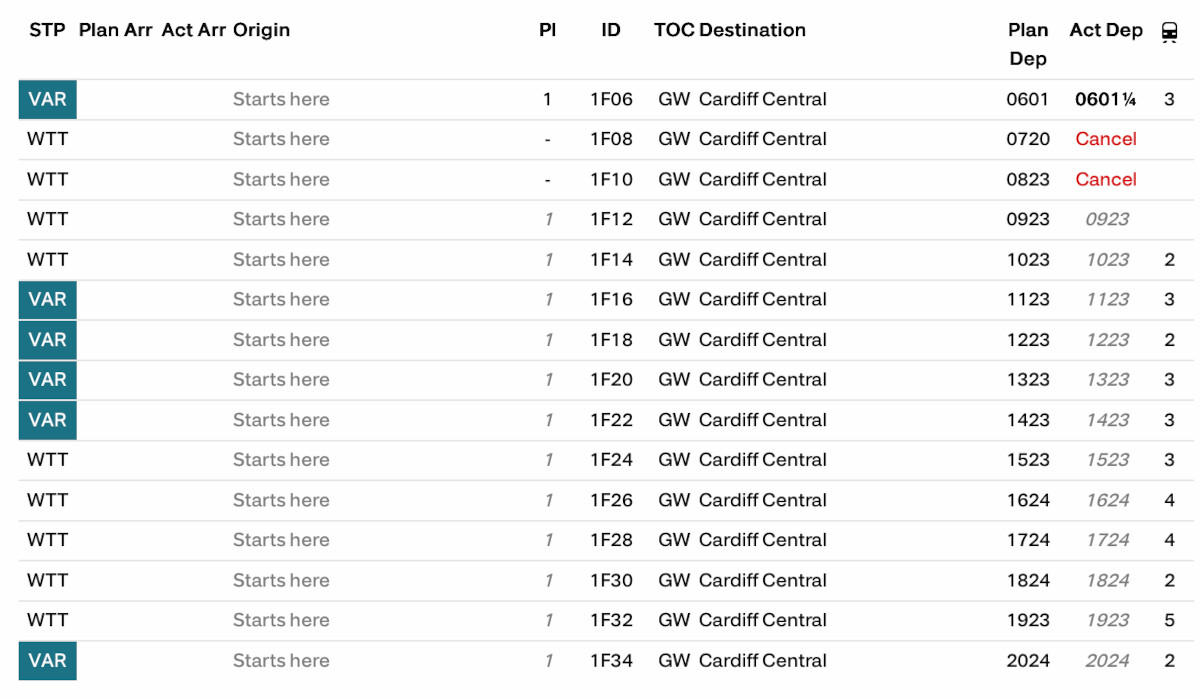
Now - let me add a couple of comments.
* I suspect that 2 carriages are adequate for the 20:24 from Portsmouth to Cardiff, though the daytime ones at 2 carriages will be "well loaded" and more.
* I cannot share the view that it must be shoddy maintenance or a complete disregard. Ongoing, such conclusions may be valid, but for a specific day there could be other issues. For example, an urgent recall / safety matter that means a sudden need to check lots of trains is - IMHO - a valid and blameless reason for a day when there are not enough trains.
| Re: 2 car trains (again) Posted by eightonedee at 12:26, 16th July 2026 | |
Presumably this is not helped by the lack of inter-operability between the Turbos (classes 165/166) and the remainder of the fleet reducing the ability to switch out and replace units if one fails?
| Re: 2 car trains (again) Posted by grahame at 18:37, 17th July 2026 | |
I have been asked about this in West Wiltshire / for Wiltshire as a whole and came up with the following to explain the situation and try to look at options available. As usual, I have written 100 words where 10 may be more effective
I can fill you in on my understanding of the rolling stock (passenger trains) situation on GWR services that operate away from electric lines. And I can look in a crystal ball and suggest some ways we may go forward - some of which may be deeply unpalatable. I have no "wow - here is a solution staring you in the face" though and am at something of a loss as to what to suggest.
** Intro
The train from Portsmouth to Cardiff runs every hour. It's a success story, and apart from late evening it needs to be 4 carriages long. At 3 carriages, many services are uncomfortably full and standing, and when it runs with just 2 carriages, you get to crush conditions and people left behind. Taking yesterday as an example - 16th July 2026 - out of 15 trains scheduled to leave Portsmouth Harbour for Cardiff, 2 cancelled, 4 were just 2 carriages in length, 4 were 3 carriages, 2 were 4 carriages and just one was 5 carriages. The length of 1 is unknown.
PreCovid, we were promised 5 carriages trains would be the standard, and since then we have been promised 4 carriages, which would suffice for a couple of years. Each physical train does a round trip every 8 hours, meaning either 32 or 40 carriages are needed. Yesterday, just 24 were provided. GWR who operate the trains also provide two further (stopping) services each hour as far as Westbury, some continuing to Salisbury and some to Weymouth. These trains are often run with as few as 2 carriages too and at that length they are often rammed.
Overcrowded trains at this level cause real problems for customers wishing to travel, and extended station stops while people struggle to get on or off, and delays build up with whole service going up the Swanee.
** Management overview
Passenger train carriages do not come cheap to lease or to operate, and both First (as GWR) and the Department for Transport want to keep the numbers down to a minimum as far as possible. At the same time, passenger numbers have increased / people want more frequent trains and I will give you a whole series of places where extra trains ("diagrams" each day) have been added in recent years.
There have been several programs to provide more trains capable of diesel operation for secondary lines in recent years, but the trains of class 769 gave such problems that they were never introduced into revenue earning passenger service, and trains of class 175 are only just coming online in the South West and that's proving far, far slower / more difficult than anticipated.
All the existing diesel trains apart from those which are designed as long distance expresses and can work on electricity too are over 30 years old, nearing the planned end of their lives. They were specified and built before we saw global warming / heatwaves like the recent ones, and they are operating (or trying to) outside their optimum design window. Some trains have become so old and inefficient that they have been withdrawn even before anything to replace them has become properly operational.
** Detail
1. Some extra services added in the last 5 years that require more none-electric trains:
* Okehampton - hourly from Exeter
* Severn Beach line - extra train every 2 hours
* Filton Abbey Wood - extra train from Bristol every hour
* Bristol local stations via Bath to Westbury and beyond - increase from 1 to 2 per hour
* Bristol direct to Oxford - one train every 2 hours
* Service to Newquay increased from every 2 hours to every hour
* Cheltenham Spa to Worcester - from every 2 hours to every hour
-- every summer, there are extra trains needed for St Ives and London-Newquay
2. Trains less available:
* Class 153 - 14 left GWR in April 2019 (not wheelchair accessible)
* Class 143 (6 trains?) withdrawn from GWR December 2021 (old age)
* Final 4 (of original 12) Castle Class trains withdrawn December 2025 (too old and expensive to run)
* Class 769 (19 x 4 car trains ) never entered service - return to lease company April 2023
* Class 175 (26 trains) - planned in 2024 but so far best achieved on any day is only 3 diagrams
* One class 158 unit written off in Salisbury accident, 31.10.2021
-- Maintenance issues on other trains that get older / spare part issues make them less available too
3. Electrics and bi-modes save some of the problems:
* Hourly London to Bedwyn service replaced by London to Newbury electrics and a single diesel shuttle train onwards
* 2nd Hourly London to Cardiff service run with standard class only London suburban electric units
* Cardiff to Penzance service (since cut to Cardiff to Exeter) aided by high speed trains that were destined for "superfast" services into London that never happened
* In theory, Battery train on Greenford branch could be saving a train
4. Services reduced / no longer operating (with GWR diesel fleet)
* from Worcester to Great Malvern
* East from Portsmouth to Brighton
* Local trains south of Salisbury to Southampton (now just one daily)
So where to the extra trains mentioned in item 1 come from?
* By reducing services that should be 2 trains joined together for capacity reasons to just one
* By savings from item 4
* By not having (I suspect) any hot spaces. We note lines closing for rest of day / extended periods now on a single failure.
* By failing to provide various enhancements such as 4 cars to Portsmouth or to Barnstaple
* By cancellations described as "more trains that usual requiring repair at the same time"
** Prognosis - trains
We are promised that when the 175 fleet becomes properly operational, it will firstly fill the gaps left by the withdrawal of the Castle Class trains, then it will take over the Barnstaple service (Okehampton too?) replacing the class 158s in use there to be transferred to Bristol. There, some are 'reserved' for the Portishead service and for the other new service to Bristol Brabazon and Henbury, and some will allow carriages to be used to run longer Cardiff - Portsmouth services. But if you look back at the history of forecasts and promises on train provision, you will see it does not have a good track record and I would not bet on it until it happens, and then be only a very muted and small improvement. These trains are hailed as saviour in so many ways - perhaps too many.
Ironically, a lot of the loading / overcrowding problems come from the very success of rail in attracting customers, with the extra frequencies described bringing in so many more travellers that just splitting the train and running twice as many but half the length does not work - it leads to overcrowding
Beyond the short term of the 175s - which are already 25 years old and were retired by Transport for Wales and stored a few years ago, what about more trains? What will we be running in 5, 10 and 20 years?
Transport for Wales have a fleet update program and are retiring class 150 trains, and then class 158 trains, both classes used by GWR. Their 20 class 150s are "life expired" and as they are withdrawn not being cascaded elsewhere on current plans. Their 24 class 158s, although only slightly younger, would be really useful but there's probably going to be a bunfight as to who gets them; just as they would allow all the Cardiff to Portsmouth service to become 4 or 5 carriages, they would be so useful elsewhere in England!
There are various trains in store at Ely, Long Marston and Derby, but if the 175s were the best of the bunch, I would be concerned at the condition of anything else that's been cold stored there, even before looking at comparability issues with other trains GWR operate and the need for staff to learn and nurse yet something else. There may be other class 150 and 158 operators retiring their stock, and Chiltern Trains have some class 165 units (and compatible 168s) - worth keeping an eye out.
New trains are being built / have recently been built for other operators such as Transport for Wales and Greater Anglia, and there is logic in looking at the possibility of "run on" orders for GWR. With pure diesel trains this is not a well received suggestion, as it's felt that partial electrification / battery power is better for the future - greener and less reliant on fossil fuel. But it is an option.
Beyond the short term - and we have issues NOW - there is much talk of new trains that will use greener technology, perhaps in addition to some diesel power. Battery technology and partial electrification is considered - for example a class of train that will run on overhead from Cardiff to north of Bristol and on 3rd rail from Southampton to Portsmouth, batteries recharged at either end, and perhaps with short sections or rapid charges between. The longer term MUST be addresses - beyond the 158s - but in my view we don't have the luxury of time on the current fleet just to wait for those marvellous new trains.
** Prognosis - services
There are lots of marvellous but somewhat pious and as yet unfunded suggestions for growth, which I applaud. But yet none of them is going to be delivered this year, and there's a massive question mark over what rolling stock would be used if it was. Until more trains / carriages are operationally available for passenger service on a daily basis, we must be very careful about adding any more diagrams!
What - could save trains? I am not advocating any of these
Terminate Cardiff - Portsmouth at Southampton and use an electric train beyond.
Start Cardiff - Portsmouth trains at Bristol and let TfW run from Bristol hourly to Swansea
Have Bristol - Southampton services call Keynsham and Oldfield Park and remove 3rd Bristol-Westbury service
Run Cheltenham Spa - London trains only as far as Swindon.
Other bi-mode savings by making people change trains at Bristol for Weston-super-mare (onto other existing services) and at Cardiff for Swansea and Carmarthen (then use class 387 electric units London - Cardiff
** In summary
Oh dear - the rail industry has failed to meet promises made by its masters, for whatever reasons. However, we need IMHO to continue to work with them - and the superb people that make up much of their team - to have provision of a cost effective rail system that will take people safely where they want to go, when they want to go, and in humane conditions.
| Re: 2 car trains (again) Posted by John D at 20:39, 17th July 2026 | |
I guess everyone has to wait until Lord Hendy produces the LTRS (the 30 year long term rolling stock strategy).
Earlier in the year suggested it would be published by the summer. Parliament has just started summer recess, so wasn't issued before the summer recess. The following suggests it will later this year
The most upto date info is the Parliamentary answer by Lord Hendy 2 days ago relating to SWR diesel fleet, I can't find any update on GWR diesel fleet
15 July 2026
The Class 158 and Class 159 diesel trains used on services between London Waterloo and Exeter are expected to be replaced as part of longer-term plans to modernise the rail fleet. South Western Railway, working with the Department for Transport, is developing proposals for their replacement; however, no specific timetable for replacement has yet been confirmed. In the meantime, these fleets are undergoing a phased refurbishment programme to improve reliability and passenger experience, including upgraded interiors, improved passenger information systems and the introduction of at-seat power. This ensures the trains remain fit for service while longer-term decisions are taken.
The Government is also developing a long-term rolling stock and infrastructure strategy, to be published later this year, which will set out Great British Railways’ future rolling stock requirements, including the approach to replacing older diesel trains.
The Class 158 and Class 159 diesel trains used on services between London Waterloo and Exeter are expected to be replaced as part of longer-term plans to modernise the rail fleet. South Western Railway, working with the Department for Transport, is developing proposals for their replacement; however, no specific timetable for replacement has yet been confirmed. In the meantime, these fleets are undergoing a phased refurbishment programme to improve reliability and passenger experience, including upgraded interiors, improved passenger information systems and the introduction of at-seat power. This ensures the trains remain fit for service while longer-term decisions are taken.
The Government is also developing a long-term rolling stock and infrastructure strategy, to be published later this year, which will set out Great British Railways’ future rolling stock requirements, including the approach to replacing older diesel trains.
https://questions-statements.parliament.uk/written-questions/detail/2026-07-06/HL1695
| Re: 2 car trains (again) Posted by grahame at 06:07, 17th August 2026 | |
08:27 Cardiff Central to Portsmouth Harbour due 11:52
Facilities on the 08:27 Cardiff Central to Portsmouth Harbour due 11:52.
Will be formed of 2 coaches instead of 4.
Facilities on the 08:27 Cardiff Central to Portsmouth Harbour due 11:52.
Will be formed of 2 coaches instead of 4.
That will be "cosy" (again)
| Re: 2 car trains (again) Posted by John D at 08:22, 28th August 2026 | |
There is local talk that the restoration of 4 or 5 coach trains on Cardiff-Portsmouth promised 2 years ago from this Decembers timetable after all the 175s are in service in Devon and Cornwall is not happening.
Clearly the 175s still do not work, and they can barely get one in service for a whole day, so idea that lots of 158s and 16x turbos can be displaced to Bristol area by end of 2026 is now looking like fiction.
Not sure what the plans are now (apart from keep hoping 175s can be made to work), more and more trains in the West Wiltshire, BANES, WECA area are busy, standing at times. And the ORR passenger numbers confirm this.
Anyone know if there is a plan B, or are regular shortages of stock the indefinite plan until further notice.
| Re: 2 car trains (again) Posted by IndustryInsider at 10:24, 28th August 2026 | |
There’s a comprehensive plan to sort out the 175 problem. As with the 180s with lots of love and care they can just about be reliable enough, so I would expect that to bear fruit at some point.
| Re: 2 car trains (again) Posted by John D at 11:09, 28th August 2026 | |
There’s a comprehensive plan to sort out the 175 problem. As with the 180s with lots of love and care they can just about be reliable enough, so I would expect that to bear fruit at some point.
Thank you for the info.
Although the phrase just about be reliable enough, doesn't fill me with confidence.
Would you happen to know if there is any truth in the stories that some of the Welsh 158s will be joining the GWR fleet, due to uncertain timescale with 175s
| Re: 2 car trains (again) Posted by IndustryInsider at 11:26, 28th August 2026 | |
I haven’t heard anything about 158s personally.
Here’s more on the Class 175 plan - which explains why less have been in service lately:
“A recovery plan is being put in place which will centre around a dedicated technical investigation team, with specialists from GWR and our industry partners Alstom and Angel.
New processes will also be introduced with enhanced pre-service checks and ensuring the trains complete a significant amount of miles without a fault occurring before they are able to go into passenger service.”
But the facts are that the 175s were fairly fragile with TfW and are from the same family as the 180s which were fairly fragile when with FGW. Having been in storage for a year or two won’t have helped.
So I think just about reliable enough is the best we can wish for!
| Re: 2 car trains (again) Posted by TaplowGreen at 16:05, 28th August 2026 | |
I haven’t heard anything about 158s personally.
Here’s more on the Class 175 plan - which explains why less have been in service lately:
“A recovery plan is being put in place which will centre around a dedicated technical investigation team, with specialists from GWR and our industry partners Alstom and Angel.
New processes will also be introduced with enhanced pre-service checks and ensuring the trains complete a significant amount of miles without a fault occurring before they are able to go into passenger service.”
But the facts are that the 175s were fairly fragile with TfW and are from the same family as the 180s which were fairly fragile when with FGW. Having been in storage for a year or two won’t have helped.
So I think just about reliable enough is the best we can wish for!
Here’s more on the Class 175 plan - which explains why less have been in service lately:
“A recovery plan is being put in place which will centre around a dedicated technical investigation team, with specialists from GWR and our industry partners Alstom and Angel.
New processes will also be introduced with enhanced pre-service checks and ensuring the trains complete a significant amount of miles without a fault occurring before they are able to go into passenger service.”
But the facts are that the 175s were fairly fragile with TfW and are from the same family as the 180s which were fairly fragile when with FGW. Having been in storage for a year or two won’t have helped.
So I think just about reliable enough is the best we can wish for!
Don't worry, it'll all be fine once it's renationalised under GBR

| Re: 2 car trains (again) Posted by trainbuff at 23:00, 28th August 2026 | |
I have been reliably told that the 175 units are also underpowered. None have been recorded cresting Hemerdon bank at more than 40mph
