









| France - railways, public transport, services and incidents (merged posts) Posted by Brucey at 19:49, 12th July 2013 |     |
I won't post the whole story here as it is constantly changing, however the BBC are currently reporting 6 people have died in a train crash near Paris.
http://www.bbc.co.uk/news/world-europe-23294630
SNCF have posted many photographs on their Twitter account: https://twitter.com/SNCF_infopresse
| Re: Train crash at Br^tigny-sur-Orge - multiple fatalities - 12 July 2013 Posted by stuving at 19:57, 12th July 2013 | |
Watching French TV, the reports are still garbled - even those commenting on SNCF's footage.
The best I can make out is that the train consisted of loco plus 6 carriages, the first two followed the loco through the station, and the third split from the second and all the last four derailed. The order of these events, and cause and effect, are not at all clear.
The third car was almost smashed to bits, and the fifth ended up sideways across a platform with the sixth on a different track altogether.
This aerial video gives an impression - the loco and first two cars are out of shot, perhaps moved.
http://www.francetvinfo.fr/faits-divers/accident-de-train-a-bretigny/video-bretigny-images-aeriennes-de-la-catastrophe-ferroviaire_368968.html
| Re: Train crash at Br^tigny-sur-Orge, near Paris - multiple fatalities - 12 July 2013 Posted by stuving at 21:51, 12th July 2013 | |
I've just seen a better aerial view, which shows two more cars so eight in all:
1,2,3 upright (but 3 may be derailed) and 4 on its side followed the loco
5 severely damaged on the wrong track
6, 7 on top of the platform canopy
8 on the original track.
This clearer video shows cars 3 and 4, though it's hard to see what they are.
http://www.francetvinfo.fr/faits-divers/accident-de-train-a-bretigny/video-bretigny-images-aeriennes-de-la-catastrophe-ferroviaire_368968.html
Clearly an event of great violence.
| Re: Train crash at Br^tigny-sur-Orge, near Paris - multiple fatalities - 12 July 2013 Posted by TonyK at 21:54, 12th July 2013 | |
Terrible.
The story accompanying that video says it is the worst accident in the past 5 years. It says also that the train left Paris a little early, but does not say whether that may be important. There has been a Red Plan activated, with fire service, ambulances, and helicopters, and the whole of the staff of all hospitals in the Ile-de-France region have been put on standby. That region is bigger than Greater London. There are many tens of people injured, some very badly, some lightly.
The Twitter feed says that three inquiries have been opened, by the police, the transport ministry, and SNCF internally.
| Re: Train crash at Br^tigny-sur-Orge, near Paris - multiple fatalities - 12 July 2013 Posted by Red Squirrel at 21:59, 12th July 2013 | |
Echoes of Potters Bar 2002..?
| Re: Train crash at Br^tigny-sur-Orge, near Paris - multiple fatalities - 12 July 2013 Posted by LiskeardRich at 22:27, 12th July 2013 | |
Echoes of Potters Bar 2002..?
This was my thoughts as well, has France been having our heat wave? Hear of speed restrictions because of rail contracting in heat. This may be a result of said effect?
| Re: Train crash at Br^tigny-sur-Orge, near Paris - multiple fatalities - 12 July 2013 Posted by TonyK at 23:03, 12th July 2013 | |
I thought of Potters Bar too, but decided to keep it to myself because the similarity as things stand is in the effect, rather than the cause. But it is eerily similar.
There was apparently permanent way work done around that area recently. It has been said on Twitter that there are 8 confirmed deaths, but that the fire service have yet to be able to get to the worst damaged carriage. This is a holiday weekend in France, and this is an awful start to it.
| Re: Train crash at Br^tigny-sur-Orge, near Paris - multiple fatalities - 12 July 2013 Posted by stuving at 23:56, 12th July 2013 | |
Yes ... a lot of things have been mentioned - most are irrelevant.
I was watching French rolling TV news, where they were running the available pictures - basically the same stills and videos you can find on the net - and egging experts (or "experts") on to give them news that had not happened yet (i.e the discovery of what caused it). Almost no attempt was made to relate the words to the very confusing pictures (which was my main motivation in trying to piece that together).
Much of the "what might have caused ..." answers brought up the shortage of cash for "classic" lines, given the cost of LGVs, until recently when RFF started to complain loudly; or the political arguments against separating off RFF, let alone outsourcing maintenance (though major works sometimes are).
From what I heard, the points that were replaced as urgent maintenance were on another line, and most reports said the middle of the train derailed first and then colliding with the station did most of the damage. There were estimated to be 370 passengers, hence the size of the emergency services call-out. Also hence the number of red herrings raised: e.g. in that number there is bound to be one passenger who says the train was going too fast, even if it was not.,
It's actually the worst accident for 25 years excluding level crossing accidents*, since French railways have a good record recently. I suspect that this is partly just random, but has given them a false sense of virtue.
A predictable part of the news reporting has been listing the major post-war rail accidents in France (mostly not familiar to me). Two struck me as worth noting:
A train that derailed on a viaduct due to buckled rails in the heat - very nasty, one carriage fell to the ground below.
The collapse of the roof of a tunnel, with two trains involved in it. this was the worst recent rail accident, with over 100 deaths. It might explain a greater sensitivity to the dangers of tunnels (which I noted elsewhere).
*revision: Allinges (described here http://www.firstgreatwestern.info/coffeeshop/index.php?topic=12589.msg135332#msg135332) was 5 years ago, with 7 deaths. However, it appears to be usual in France to exclude level crossing accidents (or deal with them separately) hence 25 years.
| Re: Train crash at Br^tigny-sur-Orge, near Paris - multiple fatalities - 12 July 2013 Posted by stuving at 10:11, 13th July 2013 | |
Further reporting this morning:
The official word is that the immediate cause is equipment not human - train speed was 137 km/h where the limit is 150.
The driver is being given credit for raising the alarm very quickly, allowing other trains to be stopped in time to avoid further collisions.
Within the common theme of "lack of maintenance/investment for over 30 years", the signalling has been cited, though none is older than 1970 and the main line is newer. There are four signal boxes within the Br^tigny area, with some equipment and trackwork as old as 1910! However, this includes operating freight yard, so again the oldest equipment will not be on or even near the main line.
The points before the station are on an embankment, and at that point there is a small bridge over a road (Av. Jules Marquis). A new, bigger, bridge has been built next to it, apparently by insertion into the embankment without closing the line. The reports now say that subsidence/settlement at this point has been detected by a track measurement train* and urgent work was carried out on another track. The track relevant to yesterday's accident was inspected and passed on July 4th.
* These use a Mauzin - a dynamometer car with two or four extra axles under it, able to duplicate specific ride characteristics and even derailment itself (i.e. simulate with real wheels and track - none of this computer modelling nonsense). I found one of these at Saint-Gilles-Croix-de-Vie last month, but it sneakily avoided being photographed, and I have not found a decent still picture on-line - the best is half-way through this: http://www.youtube.com/watch?v=AlDvMZChpuM
| Re: Train crash at Br^tigny-sur-Orge, near Paris - multiple fatalities - 12 July 2013 Posted by stuving at 10:34, 13th July 2013 | |
I have just seen an SNCF/RFF/SNCF-infra press conference. Unfortunately the TV pointed their camera at the speaker not the illustrations he referred to, but they said that a fishplate (or part of one) came loose and lodged within a flangeway of the points. Work proceeds to find out what broke (or came loose, or was loosened?) first.
| Re: Train crash at Br^tigny-sur-Orge, near Paris - multiple fatalities - 12 July 2013 Posted by Red Squirrel at 18:15, 14th July 2013 | |
I note that some tabloid reports are suggesting that passengers were electrocuted. Is that likely? Wouldn't the power have tripped out pretty quickly as soon as a derailing train shorted the circuit?
| Re: Train crash at Br^tigny-sur-Orge, near Paris - multiple fatalities - 12 July 2013 Posted by TonyK at 19:03, 14th July 2013 | |
Thought so too, Red Squirrel. I'd have thought there would have been earth leakage circuit breakers, as well as residual current protection. But if one bit can fail... who knows?
Having a background which includes light aviation, I know that most "accidents" have at least three causes. We know from SNCF's initial disclosure that there was a line fault, which is presumably the primary problem. We do not yet know what the other contributory factors are. This does get more like Potters Bar every day. I hope our railway (and especially our government) learn from the French mistakes as they are revealed, rather than making more of their own. This is not a criticism of SNCF or CoRail, or anybody French, more an expression of my own wish that all transport systems are safe, because they learn from any source available.
| Re: Train crash at Br^tigny-sur-Orge, near Paris - multiple fatalities - 12 July 2013 Posted by Red Squirrel at 19:33, 14th July 2013 | |
I'm always amused when I hear people mistaking the statement that aviation is the safest way to travel (which it may be) with the idea that it is intrinsically safe - which it plainly isn't. Aviation is safe because a lot of highly professional people work very hard indeed to keep it that way. It is harder to imagine a more intrinsically fail-dangerous form of transport than one that involves travelling 6 miles up in something that will only stay there if it keeps moving very fast.
I worry that the kind of highly-evolved safety systems that make aviation viable (let alone safe) are hard to apply to a railway organised as it is - the essence of aviation safety is no-fault reporting, yet the railways seem to have 'blame' written into every contract.
| Re: Train crash at Br^tigny-sur-Orge, near Paris - multiple fatalities - 12 July 2013 Posted by stuving at 19:36, 14th July 2013 | |
The big puzzle is still how a fishplate had four bolts holding it when inspected on 4th July, and eight days later was loose and jumping about.
The latest info says one of the bolts was still there, and the fishplate rotated, but was so close to the points it ended in the flangeway. SNCF Twitter photos in this report: http://www.rtl.fr/actualites/info/article/train-paris-limoges-les-circonstances-du-drame-se-precisent-7763126734
If someone undid it, then who? why? Could it have undone itself?
Electrocution was reported right from the start. The train mowed down several OLE supports, so the line may have dropped towards the ground before power was removed. In addition, this line is 1500V DC, not 25 kV AC, so the fault current to trip the breakers will be much higher.
| Re: Train crash at Br^tigny-sur-Orge, near Paris - multiple fatalities - 12 July 2013 Posted by Electric train at 21:30, 14th July 2013 | |
Thought so too, Red Squirrel. I'd have thought there would have been earth leakage circuit breakers, as well as residual current protection. But if one bit can fail... who knows?
Earth leakage devices are of no use on an ac rail traction systems as they have earthed return system; in the case of dc electrification systems they have an earthy traction current return system even though there is no direct connection between the rectifier negative and earth the fact the rails and ground are close enough in potential not to case a problem. The reason for not having a direct earth connection is to manage stray dc return current , also extraneous metal work like signal posts, lighting columns etc are not bonded to traction return if they are earthed to other electrical systems they are often screened by an insulting barrier.
Electrocution was reported right from the start. The train mowed down several OLE supports, so the line may have dropped towards the ground before power was removed. In addition, this line is 1500V DC, not 25 kV AC, so the fault current to trip the breakers will be much higher.
Not sure what the fault current on the French 1500V dc is, generally on traction systems the protection is there to protect the equipment and not to protect protect persons from harm, wiring regs for buildings (eg BS7671) have a emphasise to protect persons from harm. It is possible that the French operating procedure is to re-close circuit breakers after a tripping which could mean if the wreckage was clear of the OLE and the OLE remained clear of structures it could have been recharged.
| Re: Train crash at Br^tigny-sur-Orge, near Paris - multiple fatalities - 12 July 2013 Posted by SandTEngineer at 21:49, 14th July 2013 | |
Very similar to the incident at Southall back in 2002 (not the train collision one) http://www.hse.gov.uk/press/2003/e03027.htm
| Re: Train crash at Br^tigny-sur-Orge, near Paris - multiple fatalities - 12 July 2013 Posted by TonyK at 16:47, 15th July 2013 | |
... they are often screened by an insulting barrier.
Ah, les Fran^ais - quelle finesse!
But seriously, ET, I appreciate the explanation. As a barrack-room electrician only, I had missed the blindingly obvious. It seems then that the main protection from shock is normally the physical separation of equipment from civilian.
| Re: Train crash at Br^tigny-sur-Orge, near Paris - multiple fatalities - 12 July 2013 Posted by thetrout at 16:54, 15th July 2013 | |
When I saw the news about this my initial thoughts on hearing the accident was related to a set of points was actually Eschede 1998 Accident There is a Seconds from Disaster Documentary here about the accident. I'm not a great fan of the way the program is delivered, and this one easily wins a place in the irrelevant stock thread in The Lighter Side, after using MkII ExGatwick Express Stocks as a substitute for an ICE!
Eschdele was the results of a defective wheel which lead to a chain reaction of unlikely, yet unfortunate and devastating events. This included knocking over a set of points to the wrong position. What struck me as similar was that part of the train travelled over the points successfully before being diverted off the running line and hitting a bridge. I guess that would have been different if it was the Power Car Wheel that failed.
However the similarities to Potters Bar are also frightening. Indeed the collision with the Station Canopy was another part of the Potters Bar Crash.
But what was of interest to me was that it was the third coach that derailed. Just like Eschede where the leading power unit didn't derail and a trailing carriage did, although the main causes of both accidents appear to be very different. It seems odd that it was the third coach. Also seems unusual that another Train travelled over the same track about 30 minutes before the doomed train did.
I guess we can be fortunate to say that there were no Diesel involved. I'm minded of the events of Ladbroke Grove where the OHLE Equipment set the Diesel Vapours alight during the 1997 collision. If that were the case here I fear the consequences could have been much, much worse!
I also think that the contrast to the safety of Aviation vs other transport modes is ridiculous. A Pilot told me you're more likely to die slipping over in the bath than on an Aircraft. Whilst statistically he may have been right. If I'm onboard a train that crashes, take Grayrigg Accident for example. Or an Aircraft Crash... Which one am I likely to survive the most? He
| Re: Train crash at Br^tigny-sur-Orge, near Paris - multiple fatalities - 12 July 2013 Posted by JayMac at 17:06, 15th July 2013 | |
Points, switches, crossovers, call them what you will, are always going to be a weak link in the safe running, at speed, of trains.
That's why they need special attention, and regular inspection. And after any sort of maintenance they need to be checked, checked again and triple checked.
| Re: Train crash at Br^tigny-sur-Orge, near Paris - multiple fatalities - 12 July 2013 Posted by Red Squirrel at 17:09, 15th July 2013 | |
I also think that the contrast to the safety of Aviation vs other transport modes is ridiculous.
How so? Are you saying that rail has nothing to learn from the excellent safety systems used in aviation?
| Re: Train crash at Br^tigny-sur-Orge, near Paris - multiple fatalities - 12 July 2013 Posted by thetrout at 17:22, 15th July 2013 | |
I also think that the contrast to the safety of Aviation vs other transport modes is ridiculous.
How so? Are you saying that rail has nothing to learn from the excellent safety systems used in aviation?Oh gosh... I didn't word that very well at all!
No, I was saying that basing a safety record of aviation to rail is completely ridiculous. I certainly think that some aviation safety methods could work very well on the railway.
However by saying that Air Travel is statistically safer, is a little smug in of the Aviation industry in my opinion, as the methods, vehicles, training etc is very different from a Railway. If you look at the amount of times the average commuter flies every year vs the amount of trains and buses they catch every year, you may see what I'm getting at!
Also look at the amount of flights in/out of the UK every year vs the amount of timetabled trains run every year, it soon becomes apparent that you cannot base one from the other.
| Re: Train crash at Br^tigny-sur-Orge, near Paris - multiple fatalities - 12 July 2013 Posted by TonyK at 18:00, 15th July 2013 | |
I also think that the contrast to the safety of Aviation vs other transport modes is ridiculous. A Pilot told me you're more likely to die slipping over in the bath than on an Aircraft.
Uncannily, I once almost did both within 12 hours. The morning after successfully flying my first ever solo cross-country flight, I made a non-standard departure from the bath after my shower, suffering what physicists call a "rapid decrease in potential energy". I woke up sometime later, having stopped my fall with the edge of the toilet.
You are quite right about the comparison of risks in transport being futile. Walking is not without its perils, especially if done badly. The truth these days is that when we set off on a journey, it is always with the expectation of arriving safely. This is a fairly recent thing - there is still no news of John Cabot. Much of the English law relating to negligence and personal injury, and especially who is responsible for what, arose out of litigation after train crashes. That doesn't make rail travel any more or less dangerous than any other mode, just older than most. Until rail came, very few people could travel fast enough to damage themselves or others.
Air traffic control is not unlike block signalling in some senses. A piece of airspace has to be empty before another aircraft can enter it, although the majority of the sky above us is uncontrolled for small aircraft flying visually. Maintenance schedules are stringent - one of the first steps in planning a flight is to check the tech log to make sure you'll be home before the next 50 hour check is due. I assume rail operators and Network Rail have similar regimes in place. I'm struggling to think of any other similarities. Risk assessment has a dirty name these days, but it's what keeps us safe - mostly.
| Re: Train crash at Br^tigny-sur-Orge, near Paris - multiple fatalities - 12 July 2013 Posted by broadgage at 18:15, 15th July 2013 | |
I note that some tabloid reports are suggesting that passengers were electrocuted. Is that likely? Wouldn't the power have tripped out pretty quickly as soon as a derailing train shorted the circuit?
Very unlikely in my view that anyone on the train could have been electrocuted.
Whilst it is entirely possible that displaced and still live OHLE came into contact with the train, this is unlikely to be dangerous.
For electricty to be dangerous, current must pass through the body, for example by touching a live conductor whilst in contact with earth.
Someone on a train that is in contact with live wires should be safe as all parts of the train would be at same voltage.
I consider it much more likely that those on the train were killed by impact, crush injuries etc.
For someone on the platform the position is very different, a person standing on the ground could well be killed by contact with displaced overhead line equipment that remained live, even briefly.
It should be noted that overhead line failures (without any other accident) occur regretably often in the UK, often resulting in the wires contacting the train, I have never heard of anyone on the train getting an electric shock in such circumstances.
Bystanders and trackworkers would be at some risk in such circumstances.
| Re: Train crash at Br^tigny-sur-Orge, near Paris - multiple fatalities - 12 July 2013 Posted by JayMac at 18:18, 15th July 2013 | |
The morning after successfully flying my first ever solo cross-country flight,
Being that it was cross-country, were there plenty of toilets, but all smelling worse than a downtown Kolkata sewer? Did you turn up expecting a seat but had to fight for one because the reservation system had gone t*ts up? Did the on-board catering consist of nothing more than a melting Kit-Kat and a warm can of Carling, delivered to you by a trolley dolly who turned up 3 minutes before your destination?
That's my experience of travelling solo cross-country.
| Re: Train crash at Br^tigny-sur-Orge, near Paris - multiple fatalities - 12 July 2013 Posted by stuving at 19:25, 15th July 2013 | |
For someone on the platform the position is very different, a person standing on the ground could well be killed by contact with displaced overhead line equipment that remained live, even briefly.
Four of the six people killed were on platforms, though I've not found out whether this was by impact with the train, a cable or other infrastructure, or by electricity. And several people were thrown from the train as windows smashed and in some cases carriages broke up. All told, I am still amazed so few passengers were killed.
There were two SNCF staff on the platform who saw a carriage coming towards them, sideways on, at high speed. They threw themselves on the ground and the carriage was launched into the air over them and onto the canopy. Now that is really scary - others sadly were not so lucky.
At 1500 V, one ohm circuit resistance, hence 1500 A, the power (in simple terms) is 2.25 MW or about 3000 HP. That's about one train (at full power). If a supply has to cope with several trains, it has to supply a total circuit resistance of well under one ohm. So it will take a very firm contact with the ground (or grounded metalwork) to produce such a low resistance to Earth, and carry a big enough over-current to then trip the supply.
| Re: Train crash at Br^tigny-sur-Orge, near Paris - multiple fatalities - 12 July 2013 Posted by TonyK at 20:07, 15th July 2013 | |
Looking at the electrocution question again, I recall hearing that DC is more dangerous than AC, because the latter causes muscle spasm, meaning that one is likely to be thrown away from the danger. No-one on the train would be in danger in any case, but people on the platform may, sadly, have been. It remains a moot point only. Being crushed or electrocuted is unimportant compared to being killed or seriously injured.
| Re: Train crash at Br^tigny-sur-Orge, near Paris - multiple fatalities - 12 July 2013 Posted by TonyK at 20:08, 15th July 2013 | |
Being that it was cross-country, were there plenty of toilets, but all smelling worse than a downtown Kolkata sewer? Did you turn up expecting a seat but had to fight for one because the reservation system had gone t*ts up? Did the on-board catering consist of nothing more than a melting Kit-Kat and a warm can of Carling, delivered to you by a trolley dolly who turned up 3 minutes before your destination?
That's my experience of travelling solo cross-country.
That's my experience of travelling solo cross-country.
For the record, the onboard catering consisted of a packet of mint Imperials that I forgot all about once I left the ground. Toilet facilities consisted of waiting until I landed. I did have a seat, however; the left-hand one.
| Re: Train crash at Br^tigny-sur-Orge, near Paris - multiple fatalities - 12 July 2013 Posted by stuving at 20:34, 15th July 2013 | |
Looking at the electrocution question again, I recall hearing that DC is more dangerous than AC, because the latter causes muscle spasm, meaning that one is likely to be thrown away from the danger. No-one on the train would be in danger in any case, but people on the platform may, sadly, have been. It remains a moot point only. Being crushed or electrocuted is unimportant compared to being killed or seriously injured.
I think it is the other way - DC produces strong constant muscle contraction, but AC produces more of a twitch, though it can be very strong. The extra danger was supposed to be when you are gripping something and cannot let go, since hand muscles only pull one way (to grip). In other parts of the body muscles oppose each other, so the effect is less predictable.
If this effect is important, it might show up in the advice on how to rescue someone from the third rail. However, I rather think the actual advice is to keep clear, and a very out-of-date version that advised some action would be of dubious scientific basis.
Either way, what kills you is ventricular fibrillation due to the small part of the current that goes near your heart.
| Re: Train crash at Br^tigny-sur-Orge, near Paris - multiple fatalities - 12 July 2013 Posted by Electric train at 21:01, 15th July 2013 | |
... they are often screened by an insulting barrier.
Ah, les Fran^ais - quelle finesse!
But seriously, ET, I appreciate the explanation. As a barrack-room electrician only, I had missed the blindingly obvious. It seems then that the main protection from shock is normally the physical separation of equipment from civilian.
It is unlikely that anyone was electrocuted, as soon as the wire hit the ground or a return path (earth) fault clearance and limitation of rise of earth potential are governed by EN50122-2
I can not recall an incident where a passenger in a train has been electrocuted by the passage of OLE fault current through a train.
| Re: Train crash at Br^tigny-sur-Orge, near Paris - multiple fatalities - 12 July 2013 Posted by TonyK at 21:12, 15th July 2013 | |
[I can not recall an incident where a passenger in a train has been electrocuted by the passage of OLE fault current through a train.
Neither can I. The "Faraday Cage" effect would see any current running to earth around passengers, rather than through them. I have twice, in former times, seen Blackpool trams - both double-deckers - "brewed up" by a catastrophic short circuit. No passengers were harmed, although many were shaken by the sight and noise, and even more were inconvenienced.
| Re: Train crash at Br^tigny-sur-Orge, near Paris - multiple fatalities - 12 July 2013 Posted by Electric train at 21:25, 15th July 2013 | |
[I can not recall an incident where a passenger in a train has been electrocuted by the passage of OLE fault current through a train.
Neither can I. The "Faraday Cage" effect would see any current running to earth around passengers, rather than through them. I have twice, in former times, seen Blackpool trams - both double-deckers - "brewed up" by a catastrophic short circuit. No passengers were harmed, although many were shaken by the sight and noise, and even more were inconvenienced.
That's when you find out that adrenalin is brown, very runny and can be found in your under pants


| Re: Train crash at Br^tigny-sur-Orge, near Paris - multiple fatalities - 12 July 2013 Posted by ChrisB at 12:30, 17th July 2013 | |
No one has yet reported that it was a fishplate stuck in a diamond cross-over some yards north of the station...twitter photo (which I meant to grab) showed it stuck in the crossover. A loose nut on the wooden (rather old & splitting) sleeper that the diamond crossing was attached to.
| Re: Train crash at Br^tigny-sur-Orge, near Paris - multiple fatalities - 12 July 2013 Posted by stuving at 18:28, 17th July 2013 | |
No one has yet reported that it was a fishplate stuck in a diamond cross-over some yards north of the station...twitter photo (which I meant to grab) showed it stuck in the crossover. A loose nut on the wooden (rather old & splitting) sleeper that the diamond crossing was attached to.
Er - actually I did, on Saturday, and on Sunday (in http://www.firstgreatwestern.info/coffeeshop/index.php?topic=12646.msg135922#msg135922) with a link to several pictures.| Re: Train crash at Br^tigny-sur-Orge, near Paris - multiple fatalities - 12 July 2013 Posted by ChrisB at 18:39, 17th July 2013 | |
Indeed you did. It was the mention of it having rotated while attached by one bolt that threw me - the photos in that article you linked to very clearly shiws one totally loose fishplate in the diamond of the crossing damaged where the train has obviously gone over it, and another loose lying on the sleeper aside the diamond. Neither attached by one bolt
| Re: Train crash at Br^tigny-sur-Orge, near Paris - multiple fatalities - 12 July 2013 Posted by stuving at 19:04, 17th July 2013 | |
Indeed you did. It was the mention of it having rotated while attached by one bolt that threw me - the photos in that article you linked to very clearly shiws one totally loose fishplate in the diamond of the crossing damaged where the train has obviously gone over it, and another loose lying on the sleeper aside the diamond. Neither attached by one bolt
Strange - what I see in the article is a diagram that explains how it rotated, and a picture that shows one bolt in place that might or might not still be intact right through the fishplate. Clicking through to the original picture, full size, I think the bolt is still there but a bit bent (understandable after a train has gone over it). So is there another picture that shows it better?
| Re: Train crash at Br^tigny-sur-Orge, near Paris - multiple fatalities - 12 July 2013 Posted by TonyK at 20:05, 17th July 2013 | |
From Twitter, so in the public domain:
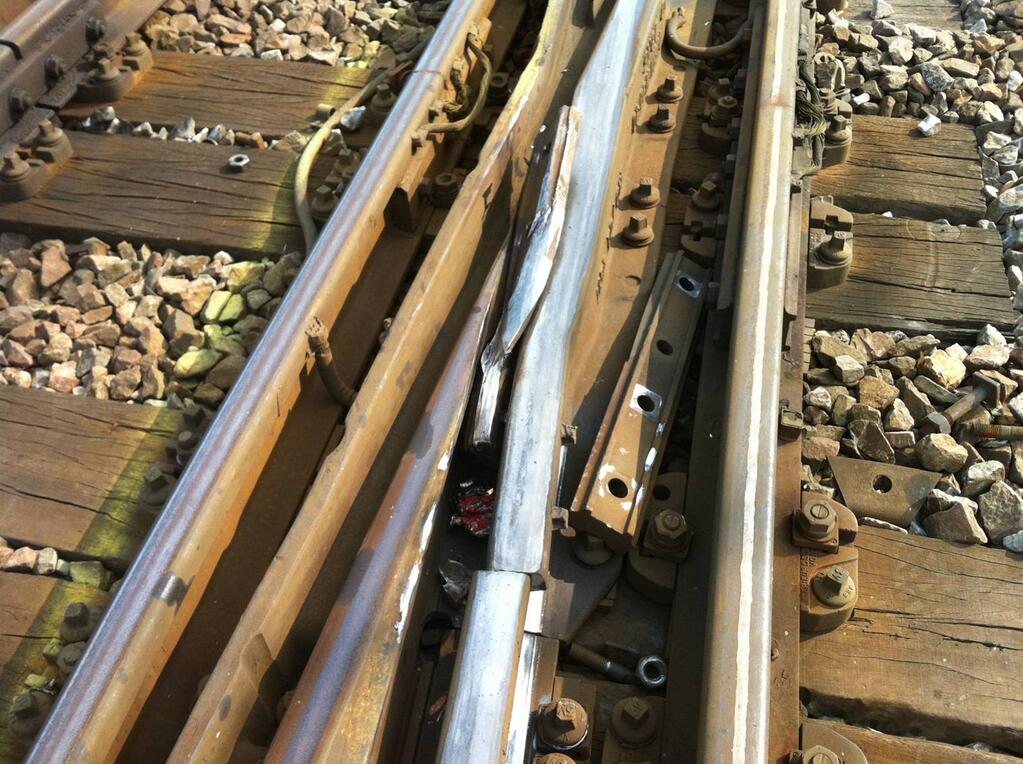
Somebody tell me if there's a copyright notice embedded. I couldn't see anything. The Twitter description says "Plan and picture of splints" - the French word "eclisse" is used for fishplate.
There's a second picture in the SNCF Twitter feed:
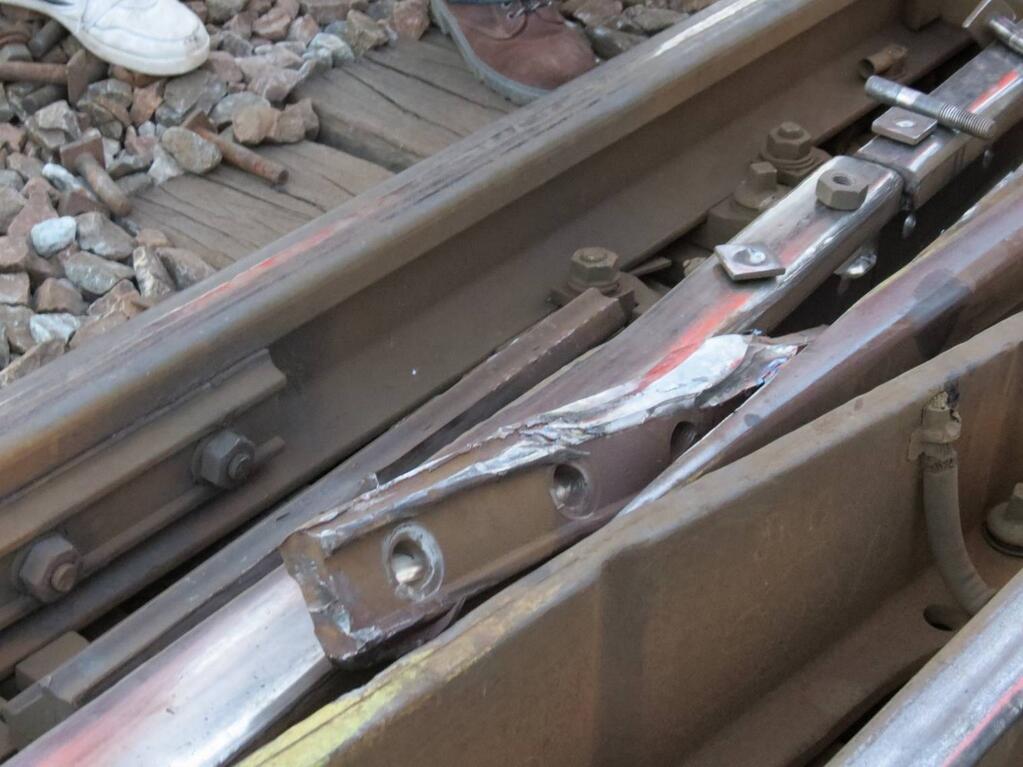
These two, and the plans are brought together in RTL.fr, which includes a quote by Jacques Rapoport of RFF, which is roughly translated as "We know what happened, but not why it happened".
Messy.
| Re: Train crash at Br^tigny-sur-Orge, near Paris - multiple fatalities - 12 July 2013 Posted by stuving at 20:08, 17th July 2013 | |
Yes - that's the one in the article I was talking about. I think you can just about see the bolt going through the rail and fishplate.
| Re: Train crash at Br^tigny-sur-Orge, near Paris - multiple fatalities - 12 July 2013 Posted by TonyK at 20:32, 17th July 2013 | |
I see what you mean, Stuving. It might not be as it looks, of course. There are what look like undamaged loose bolts in those pictures, plus the one through the rail. The metallurgist will be able to interpret this scene, to show what order everything came apart in.
| Re: Train crash at Br^tigny-sur-Orge, near Paris - multiple fatalities - 12 July 2013 Posted by stuving at 11:18, 19th July 2013 | |
A couple of things struck me in the pictures. It was always clear that the bits sitting on the rail in the second one had been collected and put there, presumably after the main legal record photos had been done. Looking closer, I see several rusty bolts, presumably discarded during earlier work. Isn't this now regarded as unacceptable in Britain, at least since Potters Bar and Grayrigg?
There are a number of new-looking loose nuts, but also what look like bolt heads (square) and shafts that have been sheared. What stands out by its absence a shaft with a nut still on it. It is not clear which way the bolts went through this particular joint - the gap on one side looks narrow enough to hinder inserting a bolt, but maybe not. You can see why the official response has been one of energetic head-scratching.
| Re: Train crash at Br^tigny-sur-Orge, near Paris - multiple fatalities - 12 July 2013 Posted by Electric train at 18:58, 19th July 2013 | |
A couple of things struck me in the pictures. It was always clear that the bits sitting on the rail in the second one had been collected and put there, presumably after the main legal record photos had been done. Looking closer, I see several rusty bolts, presumably discarded during earlier work. Isn't this now regarded as unacceptable in Britain, at least since Potters Bar and Grayrigg?
There are a number of new-looking loose nuts, but also what look like bolt heads (square) and shafts that have been sheared. What stands out by its absence a shaft with a nut still on it. It is not clear which way the bolts went through this particular joint - the gap on one side looks narrow enough to hinder inserting a bolt, but maybe not. You can see why the official response has been one of energetic head-scratching.
There are a number of new-looking loose nuts, but also what look like bolt heads (square) and shafts that have been sheared. What stands out by its absence a shaft with a nut still on it. It is not clear which way the bolts went through this particular joint - the gap on one side looks narrow enough to hinder inserting a bolt, but maybe not. You can see why the official response has been one of energetic head-scratching.
I feel the French Railways might be going through the same sort of problems that surrounded the UK Railways 10 to 12 years ago, fragmented organisation, lack of investment etc
| Re: Train crash at Br^tigny-sur-Orge, near Paris - multiple fatalities - 12 July 2013 Posted by stuving at 23:08, 11th September 2013 | |
Le Monde reported yesterday that the judicial investigators had observed over 40 anomalies in the set of points that caused the derailment. On closer reading, these are things listed by investigators with no expert knowledge, that should be referred for an expert opinion - which is not really the same. However, they still wanted to add a charge against RFF of "knowingly risking other people's lives" - which was refused by the prosecutor's office.
No sign yet of report - BEA-TT (equivalent to RAIB) seem not to do interim reports.
At the same time, CFDT (not the biggest rail union, and certainly not usually the noisiest) has tried to link this accident to the state of the Nantes to St-Gilles-Croix-de-Vie line, in a letter to the ministry. The fact that this line is in dire need of replacement is not news - as reported elsewhere on this forum. The supposed link is lack of money, due to it all going on TGVs and LGVs. Again, not much real news behind the headline.
| Re: Train crash at Br^tigny-sur-Orge, near Paris - multiple fatalities - 12 July 2013 Posted by stuving at 01:48, 24th September 2013 | |
Le Figaro has got hold of SNCF's initial report to the investigating judge, submitted on July 22nd (ten days after the accident). It concludes (from the rust in the hole) that the fishplate that jumped had been missing a bolt (No. 3) for some time. Perhaps suprisingly it was bolts 1 and 2 that sheared and it pivoted about bolt 4.
The opposite fishplate was worse, with one bolt missing, one missing a nut, and the other two loose! This passed inspection eight days earlier.
SNCF have responded with a press briefing, but with no direct recording of it - but have released the report itself: http://medias.sncf.com/sncfcom/pdf/presse/Rapport-Bretigny-Deraillement-train-n3657-12juillet2013.pdf. I'll have a further look at it tomorrow and report here, but initially it seems that Le Figaro have the basic facts.
| Re: Train crash at Br^tigny-sur-Orge, near Paris - multiple fatalities - 12 July 2013 Posted by stuving at 11:55, 24th September 2013 | |
The main points of this report are indeed the ones already noted. I won't copy all the pictures; I think most are pretty clear without the words. The damage to the brake disc in figure 7 is on the last axle of the third carriage, which did not derail. It is thus thought this contact flipped the fishplate, already bouncing up, into the flangeway.
A few other things:
- the line speed limit is 150 kph
- these Corail carriages are rated for 200kph - which surprises me a bit
- the fishplate in question is on the RH switch rail before the double slip crossing
- the fishplate in a worse state is on the LH switch rail after the same crossing
- the trackwork was installed in 1991, with a planned life of 25 years
- it looks more dated than that to me - and the wooden sleepers look a bit rough
- it is reported, but as not being a causal factor, that 20 sleepers were replaced under a another of this set of crossings in May and June 2013 (to correct a twist of 27 mm/3 m) because they were the wrong height when installed!
- all of the observations of track components have the caveat "subject to detailed metallurgical examination", or in the case of the motion of the fishplate "requiring detailed dynamical modelling"
The layout also looks dated to me - with its long diagonal track having a double slip where it crosses each running track. I've seen similar pre-war layouts here, but none in use now. Why were they thought clever then, and more importantly why are they now not acceptable? Is it anything to do with reliability and maintenance?
| Re: Train crash at Br^tigny-sur-Orge, near Paris - multiple fatalities - 12 July 2013 Posted by stuving at 09:14, 26th September 2013 | |
Another piece in Le Figaro. They have got hold of some track inspection records going back to February, and say that these did mention faults on this stretch of line. However, the detail is a bit lacking - while they say a missing bolt was recorded in February, it may have been a different one. They reproduce part of the last inspection sheet, noting it was done by a newly-appointed young engineer walking the line alone rather than with a lookout. This does note some bolts to be tightened, but none missing, and stops just before the accident location.
Severe cracking on one of the rails was recorded in April at the relevant joint, with "must repair within 3 months" urgency. It is hard to see how this could have been examined without seeing the missing bolt. One of their "experts" commented that that the inner bolts were much more important that the outer ones, to the extent that on first finding one missing you would swap a bolt from the outside. Does that sound right? I find it hard to believe.
http://www.lefigaro.fr/actualite-france/2013/09/26/01016-20130926ARTFIG00280-bretigny-des-anomalies-avaient-ete-reperees-plusieurs-mois-avant-l-accident.php
| Re: Train crash at Br^tigny-sur-Orge, near Paris - multiple fatalities - 12 July 2013 Posted by stuving at 16:10, 26th September 2013 | |
Another piece in Le Figaro. They have got hold of some track inspection records going back to February, and say that these did mention faults on this stretch of line. However, the detail is a bit lacking - while they say a missing bolt was recorded in February, it may have been a different one.
SNCF have responded immediately to point out that Le Figaro have misunderstood these inspection reports. That's easy to do, since they are written in a very abbreviated form of railway jargon. Still, on a national newspaper the journalists ought to know where they only have "a little learning". Maybe the experienced railwaymen they consulted had the wrong kind of experience?The two key errors were that the piece of the relevant double slip crossing that was cracked was actually an earth continuity connection (bond), not a rail, and the bolt noted as missing was not in a fishplate, but in a gauge tie bar. They did use the right word for this (entretoise but did not understand it.
The SNCF site http://www.sncf.com/fr/fil_info/presse/Bretigny-rapport-enquete has the three relevant inspection sheets plus a short document pointing out the errors, and that this section of track was subjected to "fixing and tightening" visit in week 12 (March). The sheets still contain lots of puzzling cryptic entries, especially the last one (4th July). I've managed to find most of the jargon words involved, but not their abbreviations.
| Re: Train crash at Br^tigny-sur-Orge, near Paris - multiple fatalities - 12/7/13 Posted by stuving at 00:21, 27th September 2013 | |
There was a TV report on SNCF's and RFF's maintenance standards tonight (Envoy^ Sp^cial, F2). Largely familiar - my favourite line to Saint-Gilles-Croix-de-Vie featured again, which everyone agrees is overdue for rebuilding, plus other lines with severe speed restrictions. Not very much directly about Br^tigny sur Orge, where the journos seemed unable to cope with the boss of SNCF saying it was almost certainly down to maintenance, and so their fault, but not admitting that it definitely was. Of course that's simply because the investigations are still underway.
Similarly, a point was made that after a low-speed derailment at Lyon two weeks earlier (26th June) SNCF instructed staff not to use the D-word. The accident is listed by BEA-TT (French for RAIB) as an ongoing investigation, so it's hardly a secret. It was apparently due to a wheel breaking up, and the programme reported that a batch of 236 wheelsets had to be traced and recalled as they were assembled using the wrong torque (on its wheel-fixing bolts, I think). That was not the cause at Lyon, after which another batch of wheelsets had to be checked.
So the picture is building up that the safety culture and organisation had slipped below the required standards. And Guillaume Pepy (SNCF boss) is already talking about pre- and post-Br^tigny eras, much as Hatfield marked a radical change of priorities here.
| Re Train crash at Br^tigny-sur-Orge - multiple fatalities - 12 July 2013 Posted by stuving at 08:56, 11th October 2013 | |
RFF and SNCF Infra announced on Tuesday an urgent programme of accelerated inspection and replacement of track, concentrated on the most heavily used S&C, called "Vigirail". This is a direct result of the Br^tigny-sur-Orge accident, and they warn that the extra possesions for the work will lead to some disruption. This follows on from the emergency work immediately after the accident, in which they claim to have inspected 5000 crossings, 100,000 fishplates, and 520,000 rail clamps in two weeks.
There is no new railway money involved, just collecting an extra ^410M according to SNCF) over four years from other budgets. Most of this is planned to double the number of replacements to 500 per year, and to recruit more staff to do it. Small amounts go on digitising the maintenance records and management, and on some new survey trains using HD video to inspect tracks.
SNCF info at http://debats.sncf.com/bretigny-sncf-et-rff-lancent-vigirail/#.UlevWFCkpcg, and full text at: http://www.rff.fr/?page=ajax_view&real_action=download&file_url=IMG/pdf/DP-Bretigny-sur-Orge_Point-presse-N6.pdf
| Re: Train crash at Br^tigny-sur-Orge - multiple fatalities - 12 July 2013 Posted by stuving at 08:24, 9th January 2014 | |
Advance news (in French) on RTL of the results of the enquiries. The first report is due out tomorrow - I think that's the interim technical report from the BEA-TT.
RTL concentrate more on the (leaked) prosecutors' report, which seems to be heading for a criminal prosecution as well as a civil liability case. The news item talks about missing bolts in fishplates that no-one is bothered about, and maintenance that was both random and not thorough enough. The other theme, which is obviously going to have political implications, is the confused relationship between RFF and SNCF, and how this clouds the responsibility for maintenance standards.
All sounds rather familiar, doesn't it?
| Re: Train crash at Br^tigny-sur-Orge, near Paris - multiple fatalities - 12 July 2013 Posted by stuving at 12:15, 10th January 2014 | |
BEA-TT produce reports very similar in style and thoroughness to RAIB's. The interim report on the Br^tigny-sur-Orge accident is no exception. Of course that means it will take a while to read through (and no English text at the moment) ... but here's an initial appreciation:
The technical explanation is in line with what we heard earlier, but with more detail. The key facts, I think, are:
- There were cracks running along a cast piece of rail, passing through the hole for a fishplate bolt.
- This rail was part of the cast central crossing*, attaching it to the plain rail on the "upstream" side.
- The cracks reached the end of this rail, where a piece broke off, leaving the fishplate free to deflect under the load of wheels.
- This bolt (No.3 in the direction of travel) must have broken months before the accident.
- The rest of the successive failures probably took place after the last inspection 8 days before the accident.
- Movement unscrewed or broke three of the bolts, each failure placing more load on those remaining.
- Finally only bolt No. 4, was left at the downstream (inner) end.
- The nut unscrewed of this bolt, and then the outer fishplate fell off.
- The bolt had too little clearance to come out, but the inner fishplate was now free to rotate and twist.
- The fishplate was then flipped up under a train ,bent and hammered into the flangeway, and derailed its last four carriages.
The report comments that this trackwork is particularly complex and needs a lot of maintaining:
- There is a diagonal link track across all five running tracks, with a double slip crossing with each.
- This is now rare, in France as here, and scheduled for replacement but not before 2025.
- The close spacing of the rails and other parts means the visibility of the underside of the trackwork was poor, and the initial fault - cracks and one broken bolt - was missed.
The country-wide inspection of similar crossings after the accident showed up a lot of deficient single fixings, though no immediate serious risks. Of course there is enough redundancy that it takes more than one bolt to fail before it causes an accident. They did find:
- 4% of examples had vertical play of > 10 mm
- 0.2% of bolts missing and 5.1% loose
- from 1.7% to 4% of fixing bolts (rail to seat and seat to sleeper) were missing or loose.
The report notes the similarity of this track failure and resulting accident to Southall (2002) and a Danish accident (Farris, 2012), but not Grayrigg (2007). In all cases they observe there were specific technical issues, as well as poor maintenance.
The immediate recommendations are as you would expect:
- Technical: to look at materials, procedures for tightening, locking of threads etc.
- Inspection: to identify areas of track that need extra attention;
- Procedures: to clarify the rules for follow-up time limits etc.
*I'm not sure what this piece is specifically called - but I now believe it is an obtuse crossing.
| Re: Train crash at Br^tigny-sur-Orge, near Paris - multiple fatalities - 12 July 2013 Posted by Electric train at 20:29, 10th January 2014 | |
The report notes the similarity of this track failure and resulting accident to Southall (2002) and a Danish accident (Farris, 2012), but not Grayrigg (2007). In all cases they observe there were specific technical issues, as well as poor maintenance.
I find there drawing a parallel with Southall strange, my recollection was not a track failure, it was Railtrack signaller / route control crossing a freight train from Southall Down West yard across to the UP Relief, which meant crossing over the DN and UP Main and DN Relief in front of a class 1 passenger train which was compounded by the ATP not functioning correctly and the drive "packing his bag"
I do think Network Rail are in a much better place than they were at the time of Grayrigg in 2007 I cannot speak for maintenance, in projects the process, procedures and checking that has to be done before, during and after any work is exceedingly onerous.
| Re: Train crash at Br^tigny-sur-Orge, near Paris - multiple fatalities - 12 July 2013 Posted by SandTEngineer at 21:38, 10th January 2014 | |
The report notes the similarity of this track failure and resulting accident to Southall (2002) and a Danish accident (Farris, 2012), but not Grayrigg (2007). In all cases they observe there were specific technical issues, as well as poor maintenance.
I find there drawing a parallel with Southall strange, my recollection was not a track failure, it was Railtrack signaller / route control crossing a freight train from Southall Down West yard across to the UP Relief, which meant crossing over the DN and UP Main and DN Relief in front of a class 1 passenger train which was compounded by the ATP not functioning correctly and the drive "packing his bag"
I do think Network Rail are in a much better place than they were at the time of Grayrigg in 2007 I cannot speak for maintenance, in projects the process, procedures and checking that has to be done before, during and after any work is exceedingly onerous.
Wrong derailment. That was the 19 September 1997 one. The one similar to the French one is that at Southall that occured on 24 November 2002 http://www.hse.gov.uk/press/2003/e03027.htm and http://www.rssb.co.uk/LEARNING/Documents/Southall%20East%20Junction%20summary.pdf
| Re: Train crash at Br^tigny-sur-Orge, near Paris - multiple fatalities - 12 July 2013 Posted by Electric train at 22:02, 10th January 2014 | |
The report notes the similarity of this track failure and resulting accident to Southall (2002) and a Danish accident (Farris, 2012), but not Grayrigg (2007). In all cases they observe there were specific technical issues, as well as poor maintenance.
I find there drawing a parallel with Southall strange, my recollection was not a track failure, it was Railtrack signaller / route control crossing a freight train from Southall Down West yard across to the UP Relief, which meant crossing over the DN and UP Main and DN Relief in front of a class 1 passenger train which was compounded by the ATP not functioning correctly and the drive "packing his bag"
I do think Network Rail are in a much better place than they were at the time of Grayrigg in 2007 I cannot speak for maintenance, in projects the process, procedures and checking that has to be done before, during and after any work is exceedingly onerous.
Wrong derailment. That was the 19 September 1997 one. The one similar to the French one is that at Southall that occured on 24 November 2002 http://www.hse.gov.uk/press/2003/e03027.htm
| Re: Train crash at Br^tigny-sur-Orge, near Paris - multiple fatalities - 12 July 2013 Posted by stuving at 08:17, 7th July 2014 | |
The next step in the process following this accident is not the final BEA-TT report, but the release of two reports done for the prosecutors' office. One is the metallurgical examination of the track components, mentioned in the BAA-TT interim report as not finished. The other is an overall report by their own appointed expert engineers. These were both delivered to the prosecutors by June, and some kind of announcement is expected today, as well as publication. However, as is usual it has already been leaked to the press - and no one seems to find this odd.
In this case Le Figaro had the story. Obviously the purpose of the main report is to allocate blame, and so it is not as studiously neutral in tone as the BAE-TT one. SNCF and RFF have already said they dispute the findings (also an entirely routine part of the legal process). Basically, the report is reported to say the poor state of maintenance was unprecedented, and due to deficiencies throughout the maintenance branch, including training. SNCF point out the inherent contradiction in that - doesn't it mean maintenance is overall good and quite adequate (as the accident record shows)? And just who are these experts anyway? More will appear soon, no doubt.
| Re: Train crash at Br^tigny-sur-Orge, near Paris - multiple fatalities - 12 July 2013 Posted by TonyK at 22:01, 7th July 2014 | |
To clarify:
A year after the disaster, the conclusions of reports commissioned by the judges in charge of the investigation are instructive for the SNCF and its maintenance procedures.
Findings:
Rail disaster 12 July 2013 last Bretigny-sur-Orge (Essonne), which killed seven people and wounded thirty, is definitely due to a maintenance problem. It is telling that the railway and metallurgical expertise has procured reports whivh Le Figaro and the prosecutor Evry shall make public on Monday. In these extremely severe reports for the SNCF, sent to judges on June 25, expert engineers (Court of Appeal of Douai) and Pierre Michel Dubernard Henquenet note that "metallurgical examinations were made possible to establish that we are not in the presence of a malicious act, and the process that led to the complete disintegration of the assembly is quite the opposite over several months and involved the entire assembly failing, from which were recorded over 200 anomalies of varying degrees of criticality. Most of these abnormalities were known from the railway company or its agents, but were not adequately remedied. The conclusion of the experts is final and evokes "dilapidation never seen elsewhere." He added: "imfrastructure perished by fatigue, vibration, beat, defects tightening, wear, etc.. Damages relating to the quality of maintenance. "
Number 3657 Intercity train consisted of seven cars Reef. There were 385 passengers on board. The train had left the Gare d'Austerlitz to 16 h 53. At 17 h 11, as it prepared to cross Br^tigny station vi platform 1, passengers felt a shock when crossing a double junction crossing . The train derailed and separated into two parts between cars 4 and while traveling at 137 km / h. the authorized speed limit on this road being 150 km / h. Due to the state of the network, the experts appointed by the judges noted in their report that "it would be desirable to limit to 100 km / hour speed trains approaching the station Br^tigny."
Inadequate monitoring network
It further notes that "current maintenance requirements" for sleepers at double junctions are "inadequate because insufficient." Currently, SNCF dismantles the spliced connections to check every three years because they are classified as "comfort items". Experts advise strongly to dismantle every year to inspect. According to them, the tour audits on channels should lead agents to "the immediate compliance", which is not the case today. The network status Br^tigny "would logically have led the SNCF to increased surveillance, and especially adapted," they write.
Experts are clearly involved in the railway maintenance organization: "There is also important to say that the SNCF staff responsible for implementation of track maintenance and equipment should be chosen according to the first criteria for solid training in engineering and in addition have received extensive specialized training. "an allusion to the youth of the agent who made the last inspection tour July 4, 2013, eight days before the accident. It was a railwayman 25, freshly graduated from an engineering school. In February 2013, he became leader of nearby lanes Br^tigny. He framed 19 agents responsible ways to do maintenance on the rail network in the industry. At the last inspection, no abnormality was reported.
Abnormalities inadequately considered
"The maintenance requirements of the SNCF, complex, difficult to interpret or apply by field workers were not fully met (...). This has led to a lack of consideration and processing of errors encountered; It should be noted in this regard that many observations made during the monitoring tours found themselves carried from one operation to another, sometimes to eventually disappear without us was sure they were treated . "And experts conclude by holding the top three factors that led to the accident by improper maintenance" repositories large maintenance superabundant, sometimes inadequate or contradictory so against-productive. "
Finally judicial engineers who conducted the inspection lane January 28 rounds alert on the status of network station of Noisy-le-Sec (Seine-Saint-Denis). They consider disturbing.
Findings:
Rail disaster 12 July 2013 last Bretigny-sur-Orge (Essonne), which killed seven people and wounded thirty, is definitely due to a maintenance problem. It is telling that the railway and metallurgical expertise has procured reports whivh Le Figaro and the prosecutor Evry shall make public on Monday. In these extremely severe reports for the SNCF, sent to judges on June 25, expert engineers (Court of Appeal of Douai) and Pierre Michel Dubernard Henquenet note that "metallurgical examinations were made possible to establish that we are not in the presence of a malicious act, and the process that led to the complete disintegration of the assembly is quite the opposite over several months and involved the entire assembly failing, from which were recorded over 200 anomalies of varying degrees of criticality. Most of these abnormalities were known from the railway company or its agents, but were not adequately remedied. The conclusion of the experts is final and evokes "dilapidation never seen elsewhere." He added: "imfrastructure perished by fatigue, vibration, beat, defects tightening, wear, etc.. Damages relating to the quality of maintenance. "
Number 3657 Intercity train consisted of seven cars Reef. There were 385 passengers on board. The train had left the Gare d'Austerlitz to 16 h 53. At 17 h 11, as it prepared to cross Br^tigny station vi platform 1, passengers felt a shock when crossing a double junction crossing . The train derailed and separated into two parts between cars 4 and while traveling at 137 km / h. the authorized speed limit on this road being 150 km / h. Due to the state of the network, the experts appointed by the judges noted in their report that "it would be desirable to limit to 100 km / hour speed trains approaching the station Br^tigny."
Inadequate monitoring network
It further notes that "current maintenance requirements" for sleepers at double junctions are "inadequate because insufficient." Currently, SNCF dismantles the spliced connections to check every three years because they are classified as "comfort items". Experts advise strongly to dismantle every year to inspect. According to them, the tour audits on channels should lead agents to "the immediate compliance", which is not the case today. The network status Br^tigny "would logically have led the SNCF to increased surveillance, and especially adapted," they write.
Experts are clearly involved in the railway maintenance organization: "There is also important to say that the SNCF staff responsible for implementation of track maintenance and equipment should be chosen according to the first criteria for solid training in engineering and in addition have received extensive specialized training. "an allusion to the youth of the agent who made the last inspection tour July 4, 2013, eight days before the accident. It was a railwayman 25, freshly graduated from an engineering school. In February 2013, he became leader of nearby lanes Br^tigny. He framed 19 agents responsible ways to do maintenance on the rail network in the industry. At the last inspection, no abnormality was reported.
Abnormalities inadequately considered
"The maintenance requirements of the SNCF, complex, difficult to interpret or apply by field workers were not fully met (...). This has led to a lack of consideration and processing of errors encountered; It should be noted in this regard that many observations made during the monitoring tours found themselves carried from one operation to another, sometimes to eventually disappear without us was sure they were treated . "And experts conclude by holding the top three factors that led to the accident by improper maintenance" repositories large maintenance superabundant, sometimes inadequate or contradictory so against-productive. "
Finally judicial engineers who conducted the inspection lane January 28 rounds alert on the status of network station of Noisy-le-Sec (Seine-Saint-Denis). They consider disturbing.
I speak French, but have used Google Translate for speed, tidied up to make sense for the the first half of the article. I'll translate further, as time allows, but the gist is that it was a Potters Bar incident, down to poor inspection and maintenance. I don't think the report was to allocate blame, the tenor of the report being largely similar to that of a report by the AAIB or RAIB - what happened, why it happened, what should be done to stop it happening again. There is reference to the judicial process, something which would not happen in the UK, although the relevant inspector could be summonsed to the criminal court proceedings, and indeed to any civil proceedings for damages.
We do not have
les ing^nieurs judiciaires
or judicial engineers in the UK, and therefore rely on legal experts to listen to two sides of the argument about what went wrong.We find it common for everyone to blame everyone else at time like this, unlike the days before rail privatisation, when if it wasn't sabotage, it was down to British Rail. France has a similar dilemma, but it ends up as a decision as to which pocket gets dipped to pay for the repairs.
J'offre mes condolednces aux familes touch^s par cet accident. C^tait vraiment tragique.
| Re: Train crash at Br^tigny-sur-Orge, near Paris - multiple fatalities - 12 July 2013 Posted by stuving at 09:52, 8th July 2014 | |
SNCF have put their side of the arguments in their "newsroom" (all in French, obviously).
They do have an obvious problem, both legally and as PR, in that the accident was caused by inadequate maintenance, which they admitted almost immediately. Worse, they identified a lot of similar pointwork in need of renewal, and set up a major programme to do that. In that context, they are trying to resist the conclusions that the whole system (or at least the non-LGV part) has been allowed to deteriorate and hence is, in general, less safe than it ought to be (i.e. "unsafe" in headline terms).
The procedure appears to be that the legal opinions ("expertises*") of the "experts*" are only published on paper, made available to the press and maybe waved at a camera in a press conference. SNCF/RFF do not get to see them in advance of publication, so are playing catch-up at this point. They have put some extracts of the latest report on-line, essentially the conclusions.
One point worth thinking about in a British context is in the translated version posted yesterday, where it refers to "the maintenance requirements of the SNCF, complex, difficult to interpret or apply by field workers..." Their point is that there is just too much written material about doing maintenance: instructions, working methods, standards, reference documents. They reckon much of it is also not suitable for it purpose, confusing, and contradictory.
There was another such expert report in June, just about the state of that specific section of track, that got a lot less attention. It was not mentioned in the BEA-TT interim report, but I think the examination was done together (i.e. this was the prosecutors' report of that examination). BEA-TT's mission is the same as the RAIB's and their reports contain a similar warning not to use them to allocate legal liability.
There is another bit of French railway bureaucracy you don't much hear about - the safety authority EPSF - answering to that part of the ORR.
They are credited with the attached little picture, which SNCF quite like as it puts them ahead of the Germans.
The head of SNCF has been saying, Rice-Daviesly, that the system is "safe". Worse, the head of RFF said it was the safest in Europe. Given that the picture is based on data to 2012, that seems hard to justify.
*Note that expert does not have the same primary meaning in French as in English when used as a noun (it does as an adjective). It means someone asked for advice or an opinion, such as the experts judiciaires in this case, and expertise has the primary meaning of an opinion, legal or otherwise. The English senses of these words are also known too, by leakage.
| Re: Train crash at Br^tigny-sur-Orge, near Paris - multiple fatalities - 12 July 2013 Posted by stuving at 16:11, 12th July 2014 | |
Following some passing comments in the latest reports, there is now confirmation (via Mediapart) that previous internal reports into maintenance elsewhere in the Paris region have been pretty poor. Specifically, at and around the Gare du Nord in 2010, an audit noted procedures not followed, the wrong tools, mistakes in rail condition monitoring, inspections not planned and scheduled and sometimes not done at all, among other things.
SNCF have fallen back on "explanations" such as: not following the rules doesn't mean it's unsafe, audits only report deficiencies so what do you expect?, if we got no deficiencies reported then we'd be worried, we started a recovery programme and some things have improved since then, etc.
Sound familiar?
| Re: Train crash at Br^tigny-sur-Orge, near Paris - multiple fatalities - 12 July 2013 Posted by stuving at 13:58, 16th September 2014 | |
RFF have been formally "mis ex examen", which is an earlier stage than a formal charge would be here. The offence is "homicides et blessures involontaires", a purely accidental kind of manslaughter, rather than the "mise en danger de la vie d'autrui" - which involves reckless conscious acts - and which some victim groups had been calling for.
The same thing will happen to SNCF on Thursday, though possibly not on the same charge. SNCF infra actually maintains the infrastructure, which RFF only manages. That will change with the the fusion of RFF and SNCF, recently voted by parliament, but not coming into effect until January 2015.
| Re: Train crash at Br^tigny-sur-Orge, near Paris - multiple fatalities - 12 July 2013 Posted by stuving at 11:43, 19th February 2015 | |
From 1st January 2015, the old RFF has been transformed into SNCF R^seau. The idea is to integrate ownership and management of rail infrastructure (RFF) with the engineering activity (SNCF Infra), at least while talking to French Socialists. This new entity has to be kept at arms length from the operating divisions of SNCF (SNCF Mobilit^s), at least while talking to European Commissioners.
However, despite well over a year's notice, neither web site yet reflects the new structure any more than the new logo and one paragraph of text on the old rff.fr site, promising a new version. I suspect that there was the predictable tug-of-war between RFF and SNCF Infra about which would take over the other, and RFF lost. The SNCF site does include the report of yesterday's meeting of a new safety oversight committee.
This new structure doesn't create any new bodies (unusually), as there already was the EPSF (cf. the safety-related bits of ORR) and BEA-TT (RAIB). It gives SNCF a central r^le in writing rules for the industry. The communiqu^ has been reported in quite different ways (no English reports, that I can see).
The headline news is that the starts of a number of big projects are being deferred, notably new LGVs (these would be regional links, mostly), station revamps, and resignalling. This is to permit resources to be shifted to the backlog of renewals work on the "classic" network. In effect, a two-year moratorium on new starts.
One TV report this morning refers to the Br^tigny-sur-Orge accident, of course, and to a report from the year before on the state of (dis)repair of the network. It suggests that money is the main consideration - a km of new line costs ^15 M against ^1 M for renovation.
This AFP report also refers to Br^tigny-sur-Orge, and the survey report done after it - plus another done in 2005 which (it says) had already led SNCF to make maintenance its priority. That does sound odd. It also says the main limited resource is specialist staff, rather than money, citing signals testers in particular - "we can't train them in two or three years, the job takes twenty years of experience"!
The following summary of the scale of thus year's renewals programme may be of interest:
- a budget of ^2.3 Bn for maintenance and ^2.6 Bn ;
- the renewal of 1,000 km of track, 400 items of S&C, and 450 km contact wire ;
- the replacement of 788 points, 280,000 sleepers, 15,000 welded track inserts (precautionary against breakages), 3,600 km of catenary as planned renewal and 563 million m^ of vegetation dealt with ;
- verification of 37,000 signaling "centres" (not sure what level that represents) in 8 months.
| France - railway and public transport services and incidents (merged posts) Posted by stuving at 20:05, 21st August 2015 | |
SNCF have developed their own version of Sod's law, which is that something always goes wrong on a summer holiday weekend. The weekends in July and August are when the long-distance network is busiest. This year's speciality is fires, as on this Marseille-Paris TGV (train 2916) that burst into flames this afternoon.
Reported (not in English) with this picture:

The last time was on August 2nd (a Sunday) and was nominally an AVE, but still an Alstom-built TGV, run jointly by RENFE and SNCF. This was at Lunel, near Montpellier, on the (scenic) route from Pars to Madrid.

As you can see that one was on 1500V DC, though as the second one was 25 kV that can't be a big factor.
That was on the biggest chass^-crois^ weekend, when the juillettistes going home fight their way past the ao^tiens going to replace them on the beaches. The same day, there was a TGV that hit a heavy farm tractor near Rennes. The tractor crashed through from a field and rolled down into a cutting. Followed by much head-scratching about what you could practically do to prevent that.
Then there was that catenary support hit by a car - 17th July, a Friday (reported in this forum).
I can vaguely remember at least on other spoiled weekend too.
| Re: If it's an August weekend, there must be a TGV on fire ... Posted by Adelante_CCT at 22:01, 21st August 2015 | |
And to add to the woes in France:
http://www.telegraph.co.uk/news/worldnews/europe/france/11817679/France-high-speed-train-shooting-what-we-know-so-far.html
| Re: If it's an August weekend, there must be a TGV on fire ... Posted by stuving at 20:39, 23rd August 2015 | |
And here's another thing ...
Today Montpellier was struck by flash flooding, for the third time in a year (it happened twice in ten days last September). A TGV was derailed by a landslip, which blocked the line from N^mes (and reportedly between Narbonne to Toulouse as well). This is not an LGV - there is a plan to build one which should be starting about now - but it is the main line from the Rhone valley towards Toulouse and Spain, and the main TGV route to Spain.
Reportedly the passengers were evacuated on another train, as they were stuck in a flooded cutting.
| Re: If it's an August weekend, there must be a TGV on fire ... Posted by Red Squirrel at 21:29, 23rd August 2015 | |
Had me confused for a moment - until I remembered there's another Montpelier somewhere...
| Re: If it's an August weekend, there must be a TGV on fire ... Posted by plymothian at 21:35, 23rd August 2015 | |
"The UK railway is shit, they never have these problems abroad..."
| Re: If it's an August weekend, there must be a TGV on fire ... Posted by stuving at 12:23, 24th August 2015 | |
Today Montpellier was struck by flash flooding, for the third time in a year (it happened twice in ten days last September). A TGV was derailed by a landslip, which blocked the line from N^mes (and reportedly between Narbonne to Toulouse as well). This is not an LGV - there is a plan to build one which should be starting about now - but it is the main line from the Rhone valley towards Toulouse and Spain, and the main TGV route to Spain.
I am impressed that SNCF had the line open initially with one track by 07:00 today, promising full operation later today, since the blockage was at 15:00 yesterday.
Incidentally, the storm struck Montpellier at 14:00 - so the rise of water to flood levels was fast. M^o France are reporting a new record rainfall rate of 110 mm/hr. Now that really is heavy rain.
| At least eleven dead as French TGV test train derails near Strasbourg - 14 November 2015 Posted by JayMac at 17:15, 14th November 2015 | |
From the BBC:
A high-speed TGV train has derailed near the eastern French city of Strasbourg, killing at least seven people, officials say.
The crash happened during a test run in the town of Eckwersheim, on a new Paris-Strasbourg line.
Reports say technicians were on board the train and seven people were injured.
The injured have been taken to hospital by helicopters.
The AFP news agency quotes the Alsace regional prefecture as saying the derailment happened due to "excessive speed".
Pictures later showed the locomotive partly submerged in a canal alongside the track. Wreckage was also scattered in a field beside the track.
Rescue teams - including divers - are working at the scene.
Reports say the Paris-Strasbourg high-speed line is scheduled to open next year.
Transport Secretary Alain Vidalies and Ecology Minister Segolene Royal will visit the scene, French media reported.
The crash happened during a test run in the town of Eckwersheim, on a new Paris-Strasbourg line.
Reports say technicians were on board the train and seven people were injured.
The injured have been taken to hospital by helicopters.
The AFP news agency quotes the Alsace regional prefecture as saying the derailment happened due to "excessive speed".
Pictures later showed the locomotive partly submerged in a canal alongside the track. Wreckage was also scattered in a field beside the track.
Rescue teams - including divers - are working at the scene.
Reports say the Paris-Strasbourg high-speed line is scheduled to open next year.
Transport Secretary Alain Vidalies and Ecology Minister Segolene Royal will visit the scene, French media reported.
| Re: At least eleven dead as French TGV test train derails near Strasbourg - 14 November 2015 Posted by TonyK at 18:50, 14th November 2015 | |
Later reports say "at least" 10 people have died, from 49 on board. This was a test run on a newly constructed line between Paris and Strasbourg.
| Re: At least eleven dead as French TGV test train derails near Strasbourg - 14 November 2015 Posted by broadgage at 18:51, 14th November 2015 | |
Very sad

I hope that this is a "normal" railway accident and not related to yesterdays terrorist attacks in Paris.
The fact that some form of test or trial was underway, rather than a scheduled passenger service, does suggest an accident perhaps whilst travelling at a greater speed than would be permitted normally.
| Re: At least eleven dead as French TGV test train derails near Strasbourg - 14 November 2015 Posted by stuving at 19:04, 14th November 2015 | |
Looking at the aerial picture in this report, an explanation in terms of "too fast for the curve" looks all to plausible. Whether that means a test run intentionally at higher speed than will be permitted later is another matter; the investigation will tell us that.
The other factor is that the front of the train is reported to have struck the bridge parapet, explaining the violence of the impact and how far the carriages have been thrown sideways.
Correction: other reports say the train was going toward Strasbourg, making this a right-hand bend - so most of the train kept going straight on and has jumped across the canal.
Inevitably this was not a major news item - there's just too much news today.
| Re: At least eleven dead as French TGV test train derails near Strasbourg - 14 November 2015 Posted by Chris from Nailsea at 19:30, 14th November 2015 | |
Inevitably this was not a major news item - there's just too much news today.
Indeed: a very sad day in France today.

As one of our members now says in his footer text: "Je suis un Parisien."

| Re: At least eleven dead as French TGV test train derails near Strasbourg - 14 November 2015 Posted by Chris from Nailsea at 19:54, 14th November 2015 | |
An update, from the BBC:
French TGV high-speed train derails near Strasbourg
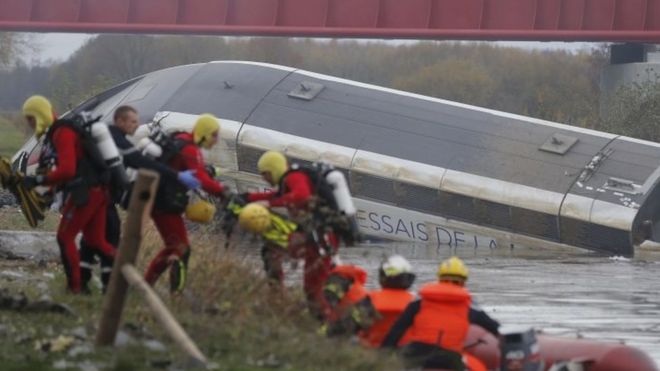
The locomotive plunged into a canal alongside the track after derailing
A high-speed TGV train has derailed near the eastern French city of Strasbourg, killing at least 10 people, officials say.
The crash happened during a test run in the town of Eckwersheim, on a new Paris-Strasbourg line.
The train was carrying 49 people when it derailed, caught fire, and plunged into a canal. The injured were airlifted to hospital.
The derailment was due to "excessive speed", officials say.
Pictures showed the locomotive partly submerged. Wreckage was also scattered in a field beside the track.
Reports say the Paris-Strasbourg high-speed line is scheduled to open next year.
Junior transport minister Alain Vidalies and Ecology Minister Segolene Royal will visit the scene, French media reported.
The locomotive plunged into a canal alongside the track after derailing
A high-speed TGV train has derailed near the eastern French city of Strasbourg, killing at least 10 people, officials say.
The crash happened during a test run in the town of Eckwersheim, on a new Paris-Strasbourg line.
The train was carrying 49 people when it derailed, caught fire, and plunged into a canal. The injured were airlifted to hospital.
The derailment was due to "excessive speed", officials say.
Pictures showed the locomotive partly submerged. Wreckage was also scattered in a field beside the track.
Reports say the Paris-Strasbourg high-speed line is scheduled to open next year.
Junior transport minister Alain Vidalies and Ecology Minister Segolene Royal will visit the scene, French media reported.
| Re: At least eleven dead as French TGV test train derails near Strasbourg - 14 November 2015 Posted by stuving at 21:10, 14th November 2015 | |
Latest TV report says that in addition to 10 confirmed deaths, there are 12 seriously injured and 5 still missing when the underwater search was suspended for the night. There were 49 aboard, including the families of some railway staff - this run was seen as marking the end of the testing phase. However, it was described doing "elevated speed" tests, and 350 km/hr was quoted but I still find it hard to believe that's possible for this curve (and it came from S^gol^ne Royale, who has a record of mis-speaking).
| Re: At least eleven dead as French TGV test train derails near Strasbourg - 14 November 2015 Posted by Chris from Nailsea at 19:41, 15th November 2015 | |
An update, from the BBC:
France TGV crash: Children on board derailed train
Several children were on board when a high-speed train derailed during a test run in France, killing 11 people, the rail company SNCF has said.
Five people are still missing and more than 30 were injured in the TGV crash near the eastern city of Strasbourg.
Investigators are trying to determine who the children are and why they were on board when access was meant to be restricted to technicians.
It is not clear whether children were among the dead.
"That's not a practice that the SNCF recognises," said company chief Guillaume Pepy. "A test train is a test train".
SNCF said it was possible that railway workers' children were on board when the train crashed, reportedly at around 350km/h (217mph).
Excessive speed has been blamed for the crash, the first fatal accident since TGV trains began operating in 1981.
The train ended up partially submerged in a canal under a bridge.
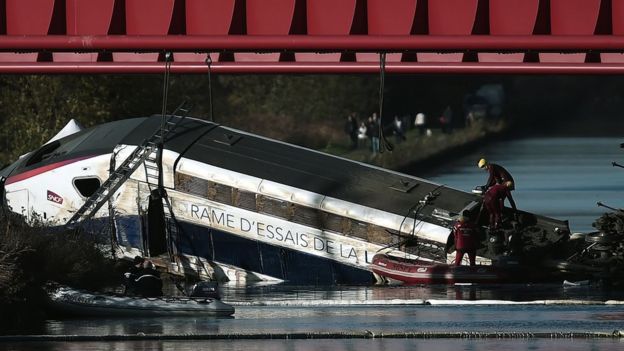
The train ended up in a canal
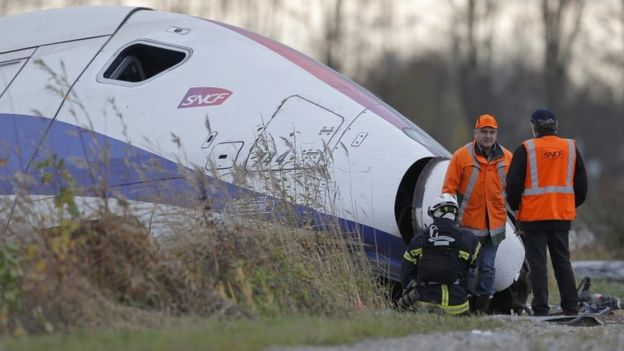
It is the first fatal crash involving a TGV in more than three decades
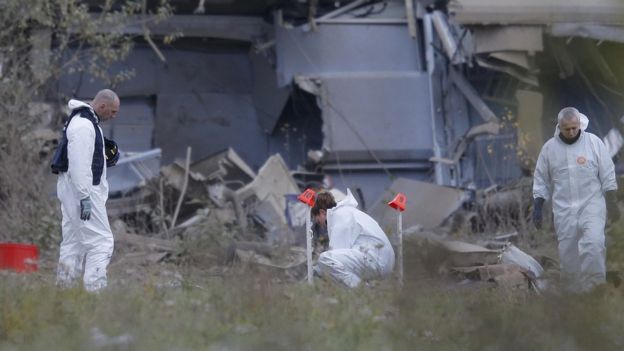
Officials say excessive speed was to blame
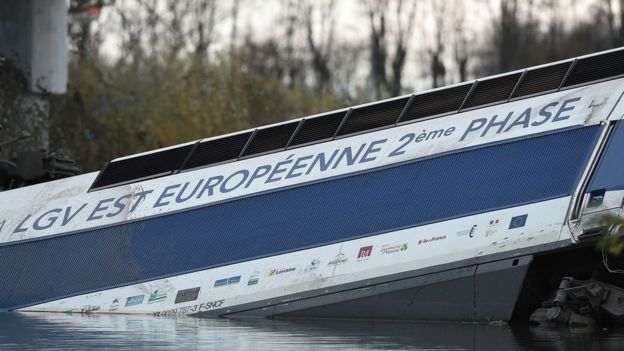
Investigators are trying to determine why children were on board
Several children were on board when a high-speed train derailed during a test run in France, killing 11 people, the rail company SNCF has said.
Five people are still missing and more than 30 were injured in the TGV crash near the eastern city of Strasbourg.
Investigators are trying to determine who the children are and why they were on board when access was meant to be restricted to technicians.
It is not clear whether children were among the dead.
"That's not a practice that the SNCF recognises," said company chief Guillaume Pepy. "A test train is a test train".
SNCF said it was possible that railway workers' children were on board when the train crashed, reportedly at around 350km/h (217mph).
Excessive speed has been blamed for the crash, the first fatal accident since TGV trains began operating in 1981.
The train ended up partially submerged in a canal under a bridge.
The train ended up in a canal
It is the first fatal crash involving a TGV in more than three decades
Officials say excessive speed was to blame
Investigators are trying to determine why children were on board
| Re: At least eleven dead as French TGV test train derails near Strasbourg - 14 November 2015 Posted by TonyK at 20:06, 15th November 2015 | |
I read a French report last night, which was more detailed. That suggested that the test crew had taken family members on what was the final test run. It did not say whether or not SNCF had sanctioned this.
| Re: At least eleven dead as French TGV test train derails near Strasbourg - 14 November 2015 Posted by stuving at 20:58, 15th November 2015 | |
The test phase using this instrumented TGV-Est train started at the end of September and runs to the end of the year, so is only about half-way through. This first part is described as proving the line at increasing speed, from 160 km/hr up to the full train and line speed of 320 km/hr and then 10% higher (352 km/hr; hence the figure of 350 km/hr that has been quoted). The site of the derailment is on a curve with a radius of about 1.3 km and just over 1 km from where it joins the existing "classic" line for the run into Strasbourg.
The five "missing" persons are now believed not to have been on board, so the casualty number is as in that last report: 11 killed and 5 still critically ill in hospital. One of those killed was a child, and their presence has still not been explained. Other reports suggest this kind of "treat" was common practice, though unofficial. If the tests have in fact reached full speed, that might seem to be the end of testing the track for faults - leaving things like the signalling and power supplies, and running over every piece of trackwork in every direction. Incidentally, on the LGV trains run on the left, so this run was in reverse. (Trains in Alsace run on the right, so the junction just ahead has to accommodate this switch.)
The investigators (SNCF, BEA-TT and gendarmerie) have recovered the train's data recorders, though presumably the signalling system will know its position and speed. The line is equipped with ETCS/ERTMS, but may not be using it at this stage; it also has the older TVM 430 system. BEA-TT do not usually give the same kind of full statement of facts at the start of an inquiry that RAIB does. However, for serious accidents like this one, SNCF will probably do something similar in a few days, and that should give the actual speed and the limit for this curve.
According to le Parisien, citing the no. 2 of SNCF R^seau, the speed limit for this bridge is 176 km/hr. They also quote Guillame Pepy as saying that these tests are run with some of the safety systems turned off.
| Re: At least eleven dead as French TGV test train derails near Strasbourg - 14 November 2015 Posted by Worcester_Passenger at 03:20, 16th November 2015 | |
Incidentally, on the LGV trains run on the left, so this run was in reverse. (Trains in Alsace run on the right, so the junction just ahead has to accommodate this switch.)
There's a schematic diagram of this flying junction at http://florent.brisou.pagesperso-orange.fr/LGVEE2.pdf, down in the bottom right corner.
| Re: At least eleven dead as French TGV test train derails near Strasbourg - 14 November 2015 Posted by Tim at 10:02, 16th November 2015 | |
Very Sad. Lets wait until the investigation. My suspicion is that they were doing something that they would not be doing in normal passenger service.
| Re: At least eleven dead as French TGV test train derails near Strasbourg - 14 November 2015 Posted by ChrisB at 10:08, 16th November 2015 | |
With kids on board.
| Re: At least eleven dead as French TGV test train derails near Strasbourg - 14 November 2015 Posted by Tim at 10:42, 16th November 2015 | |
With kids on board.
I'm not sure what to think about that.
Presumably, test trains are not regarded as risky. If they were adults wouldn't be on them either (certainly not 49 of them). Rail engineers are not, in general reckless people and these are supposed to be safe, controlled tests. I don't think that there are categories of tests that have a level of risk that is acceptable for 40 odd adults but unacceptable for the children of those adults. If there is a derailment risk then the test is not safe for anyone to be on board.
You can be sure that kids will be banned in future which is a shame because it will prevent parents sharing their pride in their work with their families.
| Re: At least eleven dead as French TGV test train derails near Strasbourg - 14 November 2015 Posted by LiskeardRich at 10:55, 16th November 2015 | |
It is known These test trains have been running 10% over speed limits with safety equipment off so as it is possible to run at limit plus 10%. The speed at derailment is not confirmed, but the speed limit at location is 160 kph, so plus 10% 176kph. This was around about the 200th test, and all the previous tests ran successfully at the plus 10%.
The train involved was the French version of our NMT train, what kind of staffing does the NMT run with?
The 5 still missing in the above report the BBC are now saying are accounted for and weren't actually on the train, but others may have been due to the "extra guests".
| Re: At least eleven dead as French TGV test train derails near Strasbourg - 14 November 2015 Posted by stuving at 12:23, 16th November 2015 | |
An update on the casualties, supposed to be final apart from four people on the danger list in hospital:
There were 53 people on board, of whom four were minors.
Eleven were killed, but none of the children.
All of the rest were classed as "injured", either slightly or now in a stable condition.
As to the risk of tests, in practice that's a matter of rules. This line was not yet signed off as ready for use, so the rules assume there is a risk that should be assessed technically and revised as tests progress. Only staff needed should be present, just as a standard precaution. SNCF house rules would allow invited guests on trains (not necessarily test trains) once the tests are all done but before all the paperwork is finished. That is reasonable enough, but is likely to be challenged once the lawyers get involved.
Normal track measurements can be done on a line open to passenger trains, so the rules for NMT would presumably be those that apply to it as a workplace. This train was a standard TGV with half the carriages refitted with test equipment, so arguably it was not all workplace in that sense. A new train was used as nothing older is built to run at full line speed, and it will presumably be converted back again. I imagine routine track geometry tests will be done with a "normal" test train, as it does not need full speed to do that out of hours.
| Re: At least eleven dead as French TGV test train derails near Strasbourg - 14 November 2015 Posted by Tim at 17:07, 16th November 2015 | |
It is known These test trains have been running 10% over speed limits with safety equipment off so as it is possible to run at limit plus 10%. The speed at derailment is not confirmed, but the speed limit at location is 160 kph, so plus 10% 176kph. This was around about the 200th test, and all the previous tests ran successfully at the plus 10%.
The train involved was the French version of our NMT train, what kind of staffing does the NMT run with?
The 5 still missing in the above report the BBC are now saying are accounted for and weren't actually on the train, but others may have been due to the "extra guests".
The train involved was the French version of our NMT train, what kind of staffing does the NMT run with?
The 5 still missing in the above report the BBC are now saying are accounted for and weren't actually on the train, but others may have been due to the "extra guests".
Thanks for the extra info. Presumably, TGVs in normal use have an automatic system to prevent the train going faster than the permitted line speed. Presumably also, when you do the 10% overspeed test you disable or override that automatic system (or you do it on track before the lineside part of that system is working) . Presumably, that then allows for human error to result in you exceeding the linespeed by more than 10%.
| Re: At least eleven dead as French TGV test train derails near Strasbourg - 14 November 2015 Posted by stuving at 17:13, 16th November 2015 | |
Thanks for the extra info. Presumably, TGVs in normal use have an automatic system to prevent the train going faster than the permitted line speed. Presumably also, when you do the 10% overspeed test you disable or override that automatic system (or you do it on track before the lineside part of that system is working) . Presumably, that then allows for human error to result in you exceeding the linespeed by more than 10%.
There's several things there we don't know - obviously you can allow a defined overspeed in several ways, only one of which is to not engage either of the safety control systems fitted. The driver survived and has been interviewed, and says he was sticking to the 176 km/hr testing speed limit. But remember, "only" 176 km/hr is still 110 mi/hr, easily enough to smash a train to pieces.
| Re: At least eleven dead as French TGV test train derails near Strasbourg - 14 November 2015 Posted by LiskeardRich at 17:27, 16th November 2015 | |
Grayrigg was about 100 mph for a comparison as to a modern train derailment in Britain under similar speeds.
The TGV was running wrong line, Looking on maps and images of the location, the wrong line looks to have a sharper curve than the normal line. The classic and high speed lines run opposite sides, and the location of crash was where two single lines fly over each other from the high speed line to swap onto the classic line to normally get to the opposite side.
The driver has been interviewed and claimed he was sticking to the limits set of 176kph.
| Re: At least eleven dead as French TGV test train derails near Strasbourg - 14 November 2015 Posted by stuving at 17:34, 16th November 2015 | |
One report I saw said this was the first run on this line in this direction at speed, though I can't see why that would be so important.
SNCF have been saying they can't confirm the actual speed as the gendarmes have the data recorders under lock and key as evidence. I still don't understand why one of the signalling systems wasn't tracking the train, even if it was not enforcing speed limits. The test phase is supposed to test the signalling too.
| Re: Train crash at Br^tigny-sur-Orge, near Paris - multiple Posted by stuving at 09:04, 17th November 2015 | |
BEA-TT published their final report on this accident in September. It didn't get much reported, as it doesn't really change anything in the interim report, so I for one missed it at the time.
BEA-TT have a page of brief summaries of their reports in English, but have not added any new ones for several years. In this case RAIB have put a summary in English on line. This emphasises the caveat that investigations for the prosecutor's office are proceeding, and were not all made available for this report. However, there is no obvious sign of a shortage of information, so that is perhaps just the formal position.
The story line of how the accident happened is still that a cracked frog on a double slip led to the bolts on a fishplate failing one at a time, until it was free to flip up under a train and jam in a flangeway. This chain of events is reconstructed in great detail by reference to the marks and indentation on the wheels and bogie components. While that might not seem entirely necessary, it was important to make sure that no other cause, even a minor one, contributed to the derailment.
The rest of the report looks at the inspection and measurement (by "Mauzin" trains) of this track, whether the faults were detected, and if so why they were not fixed. A lot of this sounds very familiar.
A couple of things are missing from the report. One is a clear statement of the impact of the restructuring of SNCF and RFF into a single organisation, which happened betwen the accident and this report. This should be slight, as SNCF did all the actual maintenance work anyway, but surely worth recording. The other is about what led to the 1500V DC power being turned off, and whether that was a fault current due to the accident, and if damaged live wires constituted a danger. This was raised by comments elsewhere, before being commented on in this forum, but is not mentioned in the report. Presumably it was not in fact an issue at all.
| Re: Train crash at Br^tigny-sur-Orge - multiple fatalities - 12 July 2013 Posted by TonyK at 19:54, 17th November 2015 | |
Advance news (in French) on RTL of the results of the enquiries. The first report is due out tomorrow - I think that's the interim technical report from the BEA-TT.
RTL concentrate more on the (leaked) prosecutors' report, which seems to be heading for a criminal prosecution as well as a civil liability case. The news item talks about missing bolts in fishplates that no-one is bothered about, and maintenance that was both random and not thorough enough. The other theme, which is obviously going to have political implications, is the confused relationship between RFF and SNCF, and how this clouds the responsibility for maintenance standards.
All sounds rather familiar, doesn't it?
RTL concentrate more on the (leaked) prosecutors' report, which seems to be heading for a criminal prosecution as well as a civil liability case. The news item talks about missing bolts in fishplates that no-one is bothered about, and maintenance that was both random and not thorough enough. The other theme, which is obviously going to have political implications, is the confused relationship between RFF and SNCF, and how this clouds the responsibility for maintenance standards.
All sounds rather familiar, doesn't it?
| Re: At least eleven dead as French TGV test train derails near Strasbourg - 14 November 2015 Posted by stuving at 17:13, 18th November 2015 | |
We were half-promised a first statement of facts from SNCF today, but examining the recorders only started this afternoon, so this first statement is now due tomorrow. I'm sure they will also have examined the track.
If you want a wider view of the site and the track, SNCF have made several videos of overflights of the "LGV Est European" while it was being built; there are links in this page. The earlier ones give a good impression of how much activity, machinery etc. it takes to build the whole line and its structures pretty well at once. The 2013 one even shows the TBM just emerged from the second bore of the Saverne tunnel.
The latest, which was done last month and so is this the most relevant, is here. It flies West-East, so the Vendenheim junction is at the end (and the helicopter was overtaken by the test train, wrong road again, 2 minutes in). Saturday's run was on the right-hand track and derailed just before the canal bridge.
| Re: At least eleven dead as French TGV test train derails near Strasbourg - 14 November 2015 Posted by stuving at 14:30, 19th November 2015 | |
We now have that statement from SNCF - and it's quite clear what the cause was: excessive speed. At the point of derailment, the recorded speed was 243 km/hr as against a normal limit of 160 km/hr. For this run, that is described as late braking; 1 km too late. (More later, when I get home.)
| Re: At least eleven dead as French TGV test train derails near Strasbourg - 14 November 2015 Posted by JayMac at 16:19, 19th November 2015 | |
Is this line left hand running throughout? Reason for asking is that I've read elsewhere that the norm is right hand running in the d^partements that border Germany (Moselle, Alsace?).
Are LGVs left hand running within France regardless?
| Re: At least eleven dead as French TGV test train derails near Strasbourg - 14 November 2015 Posted by stuving at 17:49, 19th November 2015 | |
Is this line left hand running throughout? Reason for asking is that I've read elsewhere that the norm is right hand running in the d^partements that border Germany (Moselle, Alsace?).
Are LGVs left hand running within France regardless?
Are LGVs left hand running within France regardless?
Yes, the LGV follows the normal French rule of the road up to the connector at Vendenheim. However, all lines are built and signalled for bidirectional use, hence the need to test them in both directions.
The Germans swapped most of the lines in Alsace-Lorraine over to right-hand running very soon after 1870, though the line from Strasbourg down to Basel had always been that way round. When the French came to reintegrate the A-L network with the French in 1918, swapping back would have been expensive, and in operational terms it was never a big issue, so they didn't. A bit later some of the main lines were equipped with grade-separated "leapfrog" crossovers close to the old border, such as the one at Xouaxange near Sarrebourg (and yes - that's a genuine French spelling, barbaric though it looks). At least one line built since then, like the LGV, runs on the left and has a flyover crossing (or two, I think) just before Metz at Frescaty.
| Re: At least eleven dead as French TGV test train derails near Strasbourg - 14 November 2015 Posted by stuving at 20:22, 19th November 2015 | |
The press conference today adds only a little to description of the accident. The initial technical report does describe how the train derailed; essentially it toppled over centrifugally on the curve (of only 945 m radius). Calculations give a speed of 220-240 km/hr for this to happen, and that the outer ends of the carriage rake and inner ends of the power cars should lift first. That is what happened, and the coupling at this point broke early on leaving the carriages to run off the track and straight over the canal, on their sides. The rear power car never made it over the canal, and most of the (shared) bogies were eventually ripped off.
The leading power car hit the bridge parapet and ended up in three main parts - the body crossed the bridge, scraping along the parapet/girder, and slid down the bank. The rear bogie destroyed the end of the parapet and was embedded in the end of the girder. The transformer went over the side of the bridge, and its oil burning was the source of the fires visible in the pictures.
Given that, it is remarkable that so many people survived, and in particular those in the leading power car.
The press conference, and the full statement, list four sets of actions:
- Suspend all testing at increasing speed on LGVs, and tighten both the rules on not letting outsiders onto test trains and their enforcement.
- Conduct a review of the testing methods for new lines, and the implications of this accident for the management of human factors, to report within six months.
- Certain individuals will be subject to immediate suspension and disciplinary procedures.
- A wider review of operational (not just testing) safety management and human factors is already underway, will take the review of this accident into account.
Obviously much more investigation is needed - this "immediate" report took only four days - and one area where this is true is this question: who was in the driving cab? The report says there were seven - four drivers and test managers and three others. Both of those numbers are surprising; does it need that many drivers? and doesn't driving a train at over normal line speed on the fastest line in Europe call for undivided attention?
The four staff were a driver, a second driver (who was watching), a test manager (also meant to be supervising), and a "pilot" working for Systra (the SNCF/RATP in-house engineering consultancy). Guillaume Pepy's prepared words included a rather oddly-worded section; something about ill-judged behaviour of individuals both in the driving cab and between it and the train.
All in all, it's obvious they did know speed was the cause from the start. Probably they wanted to check against the recordings before going public on that. So Pepy's insistence that this could never happen in service because of the train control systems was based on that knowledge, rather than being reassuring hyperbole. His saying the cause was unknown, which looked incompatible with that assurance, was a legal fiction (i.e. we know but need to know what the prosecutors know).
| Re: At least eleven dead as French TGV test train derails near Strasbourg - 14 November 2015 Posted by stuving at 23:33, 19th November 2015 | |
I've found a report that gives some more detail about the distribution of the casualties. I think we can assume that none of those on-board had any kind of seat belt, in which case the protection given by the body shells was pretty good.
Of the eleven people who died, none was in the front power car (and the report said that most of them were standing). That vehicle slid to a halt over 150 m, an average deceleration of 1.5 g, which helps to explain the survival rate. However, it hit the parapet very hard, and turned on its side, so I still think that survival was surprising.
Five of those killed were Systra engineering staff, and four worked for SNCF; the other two were outsiders. The highest fatality rate was in the last but one carriage, and from those figures it looks like that was a laboratory vehicle.
Sixteen people are still in hospital; two of them are still in a critical state.
| Re: At least eleven dead as French TGV test train derails near Strasbourg - 14 November 2015 Posted by Chris from Nailsea at 00:04, 20th November 2015 | |
The five "missing" persons are now believed not to have been on board, so the casualty number is as in that last report: 11 killed and 5 still critically ill in hospital. One of those killed was a child, and their presence has still not been explained. Other reports suggest this kind of "treat" was common practice, though unofficial.
An update on the casualties, supposed to be final apart from four people on the danger list in hospital:
There were 53 people on board, of whom four were minors.
Eleven were killed, but none of the children.
All of the rest were classed as "injured", either slightly or now in a stable condition.
There were 53 people on board, of whom four were minors.
Eleven were killed, but none of the children.
All of the rest were classed as "injured", either slightly or now in a stable condition.
So, are we now sure that no children were among the dead?

| Re: At least eleven dead as French TGV test train derails near Strasbourg - 14 November 2015 Posted by stuving at 00:21, 20th November 2015 | |
So, are we now sure that no children were among the dead? 
Yes, the figures are now given as definitive. However, the identity of the two still on the danger list has not been made public. You will understand that in this kind of accident, with carriages sliding along on their sides, it was always going to be difficult to count the number of those killed and no longer inside.
| Re: At least eleven dead as French TGV test train derails near Strasbourg - 14 November 2015 Posted by SandTEngineer at 10:56, 20th November 2015 | |
I would like to thank Stuving for finding and posting all of the relevant information concerning this very tragic incident.
And just to add a little bit to it, this article has a graph showing the train speeds involved:
http://www.railjournal.com/index.php/europe/late-braking-blamed-for-tgv-est-derailment.html?channel=537
| Re: At least eleven dead as French TGV test train derails near Strasbourg - 14 November 2015 Posted by stuving at 13:02, 20th November 2015 | |
The identity of some of the victims is now known. Of the five Systra staff, four held senior positions either for the trials or for the LGV Est as a whole. The wife of one of those was also killed, as was another female guest of a Systra employee who survived.
One of the four SNCF staff killed was Alain Cuccaroni, director of the LGV Est project for RFF and SNCF R^seau since its construction was approved in 1998.
Yesterday's report does contain pictures of the site and the wreckage, much of which can be followed without reading the text. The reason for the high death toll in the last but one carriage is visible in one of the pictures; it went across the canal sideways and hit the far bank upside down.
Thanks for the mention, SandTEngineer, obviously I hope it is of interest. In this case it's not just to draw comparisons, which applies in any serious accident - the "could it happen here" question - but also because what would ordinarily be the lead news item, and for several days in France, has been pushed down or out of the running order. "Interesting times" indeed, in the worst possible way.
| Re: At least eleven dead as French TGV test train derails near Strasbourg - 14 November 2015 Posted by stuving at 00:03, 22nd November 2015 | |
SNCF have posted full English transcript of Thursday's press conference. I'd add a couple of notes to it:
These SNCF internal auditors are not accountants, they look at safety, project management, and other operational matters.
The French Plateforme means the trackbed or formation, but has been unidiomatically translated as platform.
Their version of Guillaume Pepy's sentence that I commented on before reads:
Finally, it surely reveals errors of human behaviour in the driver's cab and in the communication between the cab and the rest of the trainset, which the investigation will examine.
I have read something about the test manager in the driver's cab being distracted by a long conversation on the intercom, though that doesn't sound very serious. Perhaps it was, and we will hear more about it later.
| Re: At least eleven dead as French TGV test train derails near Strasbourg - 14 November 2015 Posted by SandTEngineer at 10:31, 22nd November 2015 | |
I also found this interesting (actually somewhat alarming):
https://ressources.data.sncf.com/explore/dataset/incidents-securite/?tab=table&sort=date
| Re: At least eleven dead as French TGV test train derails near Strasbourg - 14 November 2015 Posted by stuving at 11:26, 22nd November 2015 | |
I also found this interesting (actually somewhat alarming):
https://ressources.data.sncf.com/explore/dataset/incidents-securite/?tab=table&sort=date
https://ressources.data.sncf.com/explore/dataset/incidents-securite/?tab=table&sort=date
I'm inclined to agree, though it's hard to judge how alarming this list of accidents and incidents is without something similar from the British railway network to compare it with.
A lot of the incidents are minor, so a total of over 700 during the last year (i.e. 2 per day) may or may not be very high. The fact that more than 30% of them are graded "ESR", meaning there was a potential danger to life, is what I find troubling.
| Re: Train crash at Br^tigny-sur-Orge - multiple fatalities - 12 July 2013 Posted by stuving at 14:01, 27th January 2016 | |
The criminal investigation of this accident is still going on, and Le Canard Enchain^ is today suggesting that SNCF (now with added RFF) is schooling its staff in what to say to the prosecutors. On the evidence, it's pretty clear that SNCF/RFF are guilty of some kind of manslaughter. If there is still something SNCF fear, it is probably that the current charge (accidentally causing death) is replaced by one of recklessness or wilful causing death.
Is this a shock horror scandal story, or just the French way of doing things? It's hard to say, though some of its features (prosecutors tapping witnesses' phones, the leaking of what should be secret prosecution details to the press) are very French.
I can imagine that an employer would want to warn staff about what to expect - along the lines of:
- Just answer the questions. You'll have enough difficulty dealing with that, without volunteering information on extra topics.
- Be very careful what you say and how you say it. If you later correct something that's not quite right, they may still keep coming back with your incorrect version and saying it's "the truth" and the rest is all lies.
- Stick to what you know directly, and never mention rumours or things that "everyone knows".
- If you are asked about rumours, morale, or that kind of subjective stuff, make clear in every reply that it is just your impression and may be wrong.
- Remember that prosecutors are not objective, they have their own agendas - political, internal office politics, various prejudices, personal ambition, etc.
Of course that could easily then go on to rehearsing the "story" and editing its text, which I guess we'd all call manipulation (or perverting of the course of justice, if wearing a suit). SNCF have refused to comment on a story based on leaked documents.
Le Canard Enchain^ is resolutely old-fashioned, and its accommodation of the internet age extends just far enough to put a facsimile of its front page on line. This story isn't on the front page, so there's only the like of this second-hand version.
