







| Historical Record Perception - Correction / Confirmation Required Posted by PhilWakely at 11:36, 27th October 2026 |     |
I have lived alongside the Waterloo to Exeter line in or near Pinhoe for all bar three years of my Seventy years and have always been interested in the fortunes of the line. My A-Level Statistics project, which gained an A grade was on the subject of 'Re-doubling the railway between Wilton and Pinhoe'.
However, one significant event in the history of the line puzzles me and I'd like confirmation or correction of my memory please.
Every article I read on the reasons for reducing Wilton South to Pinhoe to mainly single track and thus the route to Secondary status, was down entirely to Dr Beeching. However, my recollection is that was only the beginning - with the closure of several intermediate stations. My recollection is that control of the Salisbury to Exeter route was transferred from BR(S) to BR(W) in the early 60s and that Senior Management of BR(W) did not want two fast routes into the westcountry (the ACE was faster to Exeter than the Cornish Riviera at the time). So, BR(W) throttled the ACE in the timetable and made the decision to reduce the route to Secondary status.
Can somebody confirm / correct my perception please?
*** Correction of unfortunate typo in the first sentence ***
| Re: Historical Record Perception - Correction / Confirmation Required Posted by Richard Fairhurst at 11:53, 27th October 2026 | |
I'll try and find my copy later but Gerry Fiennes' "I Tried to Run a Railway" is very good on the decisions behind retention of the line. He was not impressed with the support forthcoming, or not, from local politicians.
| Re: Historical Record Perception - Correction / Confirmation Required Posted by ChrisB at 11:53, 27th October 2026 | |
I have loved alongside the Waterloo to Exeter line in or near Pinhoe for all bar three years of my Seventy years
Love this! too much info maybe?


| Re: Historical Record Perception - Correction / Confirmation Required Posted by JohnM at 11:59, 27th October 2026 | |
AI can be pretty good at this sort of thing, although it's not easy to tell whether it's correct or not:
Phil's historical recollection contains a mix of accurate details and a few misconceptions regarding the administration and operational changes of the line:
- The Regional Transfer (Incorrect): Phil suggests that control of the Salisbury to Exeter route was transferred from the Southern Region (BR(S)) to the Western Region (BR(W)) in the early 1960s, and that Western Region management deliberately throttled the Atlantic Coast Express (ACE) because they didn't want a competing fast route into the West Country. In reality, the entire line from Salisbury to Exeter remained under the management and control of British Railways' Southern Region right up until the major singling and rationalisation carried out in 1967 (well after the Beeching Report and after steam had ended on the route). Management control didn't shift to the Western Region until even later (the line was formally transferred to the Western Region in the 1970s, long after the singling cuts took place).
- The Beeching Cuts & Singling (Partially Correct): The reduction of the Wilton-Pinhoe section to predominantly single track was part of the wider post-Beeching rationalisation implemented in June 1967, rather than an immediate result of Beeching's original 1963 report itself. While local intermediate stations and branches (like Lyme Regis, Sidmouth, and Chard) were indeed closed under the Beeching axe, the decision to single the core line was driven by British Railways' financial and traffic-reduction policies of that era to save on maintenance costs, rather than an inter-regional conspiracy by Western Region management to handicap the ACE.
- The Atlantic Coast Express (Contextual Accuracy): The ACE was indeed a premier express service, and its timings and fortunes degraded sharply in the final years of steam and early dieselization due to general network economies, falling passenger numbers with the rise of private cars, and eventual rerouting/withdrawal, but this happened under Southern Region stewardship prior to the route's major truncation.
| Re: Historical Record Perception - Correction / Confirmation Required Posted by bradshaw at 20:03, 27th October 2026 | |
Born in Crewkerne and lived there until the late 1960s. My recollection that the WR took over the running of the train service at the change of timetable in autumn 1964. One week it was virtually all steam bar a couple of services. With the timetable change in September the Warships had taken over, with a couple of other working by Hymek and dmu. The two surveys we took seem to confirm that.
The Warships were working over the line before that. In August 1964, D816 was on the 07.30 Exeter Waterloo on the 29th of August. On the same date the 09.30 Exmouth -Waterloo was hauled by D831. The 10.33 Exeter-Yeovil was a dmu, as was its return working to Exeter. D831 returned on the Brighton Plymouth, changing from a Pacific at Salisbury. D816 returned on the 13.00 Waterloo. The Yeovil shuttle was 6430. (Traffic survey at Yeovil Junction 07.30 to 21.44)
On December 24 1964 at Salisbury from 08.20 to 17.00.
D816 06.20 Exd to Wat, D824 07.30 Exd to Wat, D804 09.00 Wat to Exd, dmu 09.48 Exd to Sal, D810 10.30 Exd to Sal and 34051 to Wat. D869 11.00 Wat to Exd, D813 Brighton to Plymouth (34039 from Brighton). Dmu 10.05 Okehampton to Salisbury, D816 13.00 Wat to Exd, D7046 10.55 Plymouth to Brighton/Portsmouth, change to 34039 at Salisbury. Train to Ilfracombe at 16.20 34012 change to D7046 to the west. D815 14.30 Exd to Wat. D824 15.00 Wat to Exd
All the SR services were steam hauled.
Feinnes p99 onwards gives his side of the story.
Singling took place in 1967 but it was realised that more double track was needed. Luckily the line between Yeovil and Templecombe was still double track so the closed line was reopened.
http://www.trainweb.org/railwest/railco/sr/se1967.html for further detail.
| Re: Historical Record Perception - Correction / Confirmation Required Posted by Ralph Ayres at 20:54, 27th October 2026 | |
I've never understood how singling an existing line gives any significant saving, except in the short-term if track needs imminent replacement or a problem such as subsidence can be avoided by taking one track out of use. Longer term there will be minor savings such as less track to inspect, but double track would broadly deteriorate at half the speed with each line only having half the usage, and the track is less complex with fewer sets of points to maintain or go wrong at passing places. Knock-on delays if one train is late and more widely the lack of flexibility in timetabling when trains can only pass at specific points on single tracks will also incur costs.
| Re: Historical Record Perception - Correction / Confirmation Required Posted by grahame at 08:08, 28th October 2026 | |
Singling took place in 1967 ...
I am NOT an expert on what happened and what didn't ... but I do note that 1967 was also when Thngley Junction to Bradford Junction and Swindon to Kemble were singled, so the singling looks like it was part of a wider process; whether there was any bias towards being more Draconian on the Salisbury to Exeter line, I know not.
When was Castle Cary to Dorchester singled?
| Re: Historical Record Perception - Correction / Confirmation Required Posted by TaplowGreen at 08:24, 28th October 2026 | |
I have loved alongside the Waterloo to Exeter line in or near Pinhoe for all bar three years of my Seventy years
Love this! too much info maybe?
Possibly explains the need for reinforcement work to the embankments?
| Re: Historical Record Perception - Correction / Confirmation Required Posted by bradshaw at 09:43, 28th October 2026 | |
Castle Cary to Dorchester singled May 1968
| Re: Historical Record Perception - Correction / Confirmation Required Posted by Chris from Nailsea at 10:53, 28th October 2026 | |
Are you sure about that?

| Re: Historical Record Perception - Correction / Confirmation Required Posted by Witham Bobby at 11:16, 28th October 2026 | |
I have lived alongside the Waterloo to Exeter line in or near Pinhoe for all bar three years of my Seventy years and have always been interested in the fortunes of the line. My A-Level Statistics project, which gained an A grade was on the subject of 'Re-doubling the railway between Wilton and Pinhoe'.
However, one significant event in the history of the line puzzles me and I'd like confirmation or correction of my memory please.
Every article I read on the reasons for reducing Wilton South to Pinhoe to mainly single track and thus the route to Secondary status, was down entirely to Dr Beeching. However, my recollection is that was only the beginning - with the closure of several intermediate stations. My recollection is that control of the Salisbury to Exeter route was transferred from BR(S) to BR(W) in the early 60s and that Senior Management of BR(W) did not want two fast routes into the westcountry (the ACE was faster to Exeter than the Cornish Riviera at the time). So, BR(W) throttled the ACE in the timetable and made the decision to reduce the route to Secondary status.
Can somebody confirm / correct my perception please?
*** Correction of unfortunate typo in the first sentence ***
I'd not be surprised in the least bit if the Western management wanted to throttle the Southern road to Exeter (The Mule). You have only to look at what they did to their own lines with closure of stations and routes wholesale, and singling to "save money". The S&D was wiped out without much thought.
Having encountered some of the senior management through the 1970s and their unimaginative attitudes, it's quite believable that they just wanted to unburden themselves of loss-making routes and stations. They were all true believers in the numbers that the closure-orientated accountants came up with. It's widely understood that the books were cooked to help make the case for closures.
The easy thing to do was to propose closures. In preference to producing imaginative ways of using the assets and infrastructure to operate the railway less expensively and boost income.
The theory would have been that singling The Mule (with a starting point exactly on the regional boundary at Wilton) and reduction of the service on that route would drive more traffic onto the Western line. I'm not sure how much that happened. I suspect that people would have either tolerated the thin service or resorted to their cars for the full journey, rather than bookend a journey to/from London with car or 'bus travel to/from a station remote from where they were starting from or wanted to be
| Re: Historical Record Perception - Correction / Confirmation Required Posted by bradshaw at 14:38, 28th October 2026 | |
In some ways the change to a two hourly service calling at all stations was preferable to the older express and stopper service. For most of the stations, like Crewkerne, we now had a direct service to Waterloo and Exeter. No more changing from the stopper on to the express at Yeovil.
I would suggest that this direct service was the turning point for the customer base.
The obvious downside was the unsuitability of the diesel hydraulics running this type of service. Many times we had a class 33 on its own or piloting a failed Warship.
Around 1972 the 33s took over, their consist reduced in winter by one coach. Probably switching iff the eth when extra power was needed! There followed the Class 47s and 50s
| Re: Historical Record Perception - Correction / Confirmation Required Posted by Mark A at 16:36, 28th October 2026 | |
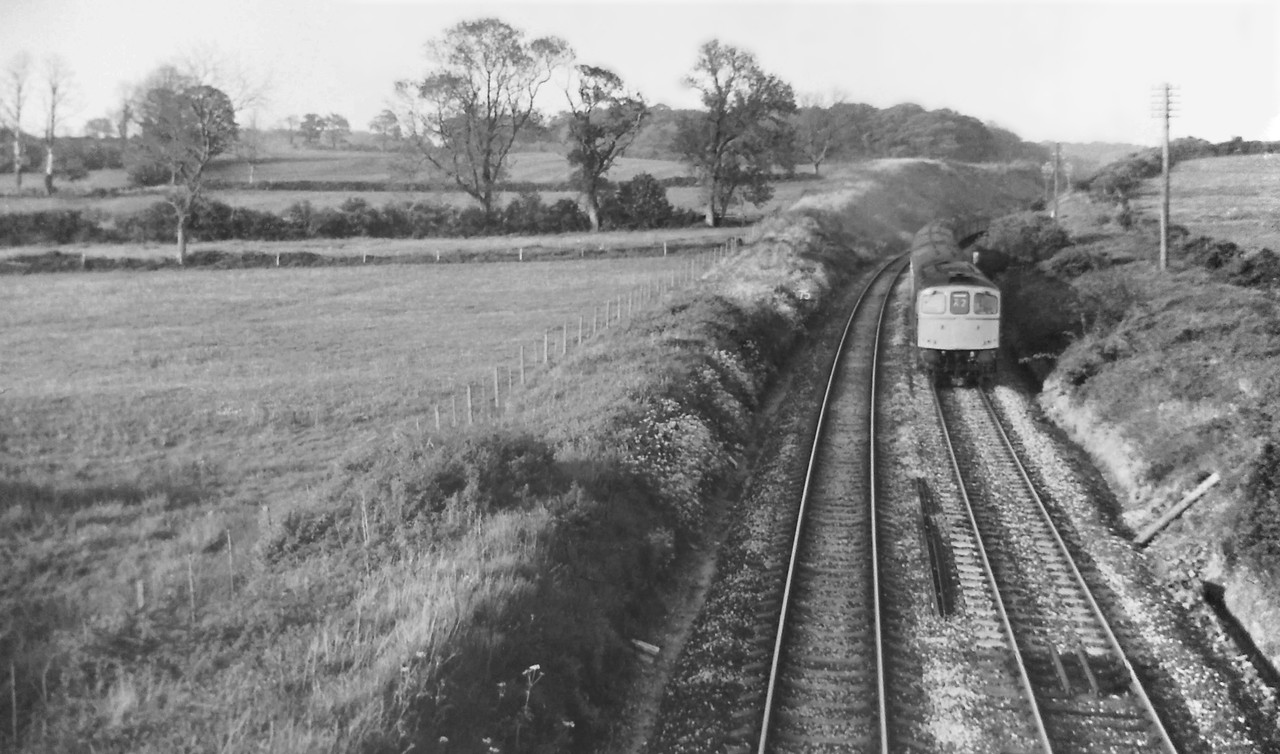
I've probably slung this photo before - and am trying to recall the date. Taken from what is possibly an obscure location for photography - an overbridge south of Stowell Hill just west of Templecombe - while visiting a friend who had a work placement in the area, and out on bikes for an explore. Late afternoon, a distant sound from an approaching locomotive before the train swept in to sight from the cutting.