






| GWR reassures passengers: No radical change after nationalisation on 13 Dec 2026 Posted by Chris from Nailsea at 22:30, 12th November 2026 |     |
From the BBC:
No radical change after nationalisation, GWR says

Great Western Railways will go back into national ownership from 13 December - Image © Press Association
The boss of Great Western Railway (GWR) has said customers should not expect "radically different" change ahead of the company returning to public ownership next month.
From 13 December 2026, a new company called Greater Western Railway Limited will operate the services, replacing First Greater Western Limited, as part of the government's plan to nationalise all rail services in England by 2027.
Speaking on BBC Radio Gloucestershire's Your Voice segment, GWR managing director Mark Hopwood said staff had been working hard behind the scenes to ensure passengers do not notice too much change. Fundamentally, it's going to be the same staff on the same trains at the same stations," he said.

Mark Hopwood says GWR customers will not notice a "radical change"
The GWR boss added: "I think people should be reassured that this isn't a change that's going to make everything radically different, but it will be a change that I think will put the right foundations in for us to build a better railway."
The Swindon-based operator, which is owned by FirstGroup, has run services and linked London to the south-west of England and Wales since 1996.
Several rail firms around the country are already publicly owned, including Great Anglia and South Western Railway. Welsh services were nationalised in 2021 and Scotland took trains into public ownership the following year.
While there will be little immediate change to day-to-day services and timetables, Hopwood said they were working on future plans, including freeing up more carriages for services. "We have got a plan to lengthen some trains, but we don't have enough rolling stock to lengthen everything," he explained.
"We are currently introducing some additional rolling stock in Devon and Cornwall and that is then releasing some trains to lengthen services in this part of the world. Perhaps not as many as everyone would like, but it is important that we take this step by step."
Hopwood also addressed commuter concerns over cancellations and delays.
One passenger who works in Birmingham said he found commuting "frustrating" due to cancellations which often make him late for work. "Since the last month it has been horrible," Adedoio said. "I'll have to do an extra hour at work to cover up my hour that the train has been delayed."
Responding to concerns about a lack of drivers, Hopwood said the company has "more drivers than ever before". However, he added: "We've got a lot more trains being cancelled than I would like. A lot of the issues that we've seen on my side of the business are more about rolling stock than drivers."
Hopwood said it had been a challenging summer due to the extreme weather and there were ongoing discussions about replacing some of the older trains in the future. He said: "In the summer, the higher temperatures are an issue. And I think they're particularly an issue for our older diesel trains that were built in the 1980s, the early 1990s. They either don't have air conditioning or they have a very basic version. And they're the trains that I'm really keen to get replaced."
Hopwood said it was hoped nationalisation would help to bring in more funding. "We haven't fully recovered from what happened during Covid because we've got more people working from home, we've got more people travelling off-peak, and while that's great for those people, it has reduced our revenue. So, the government is subsidising the railway quite a lot."
Great Western Railways will go back into national ownership from 13 December - Image © Press Association
The boss of Great Western Railway (GWR) has said customers should not expect "radically different" change ahead of the company returning to public ownership next month.
From 13 December 2026, a new company called Greater Western Railway Limited will operate the services, replacing First Greater Western Limited, as part of the government's plan to nationalise all rail services in England by 2027.
Speaking on BBC Radio Gloucestershire's Your Voice segment, GWR managing director Mark Hopwood said staff had been working hard behind the scenes to ensure passengers do not notice too much change. Fundamentally, it's going to be the same staff on the same trains at the same stations," he said.
Mark Hopwood says GWR customers will not notice a "radical change"
The GWR boss added: "I think people should be reassured that this isn't a change that's going to make everything radically different, but it will be a change that I think will put the right foundations in for us to build a better railway."
The Swindon-based operator, which is owned by FirstGroup, has run services and linked London to the south-west of England and Wales since 1996.
Several rail firms around the country are already publicly owned, including Great Anglia and South Western Railway. Welsh services were nationalised in 2021 and Scotland took trains into public ownership the following year.
While there will be little immediate change to day-to-day services and timetables, Hopwood said they were working on future plans, including freeing up more carriages for services. "We have got a plan to lengthen some trains, but we don't have enough rolling stock to lengthen everything," he explained.
"We are currently introducing some additional rolling stock in Devon and Cornwall and that is then releasing some trains to lengthen services in this part of the world. Perhaps not as many as everyone would like, but it is important that we take this step by step."
Hopwood also addressed commuter concerns over cancellations and delays.
One passenger who works in Birmingham said he found commuting "frustrating" due to cancellations which often make him late for work. "Since the last month it has been horrible," Adedoio said. "I'll have to do an extra hour at work to cover up my hour that the train has been delayed."
Responding to concerns about a lack of drivers, Hopwood said the company has "more drivers than ever before". However, he added: "We've got a lot more trains being cancelled than I would like. A lot of the issues that we've seen on my side of the business are more about rolling stock than drivers."
Hopwood said it had been a challenging summer due to the extreme weather and there were ongoing discussions about replacing some of the older trains in the future. He said: "In the summer, the higher temperatures are an issue. And I think they're particularly an issue for our older diesel trains that were built in the 1980s, the early 1990s. They either don't have air conditioning or they have a very basic version. And they're the trains that I'm really keen to get replaced."
Hopwood said it was hoped nationalisation would help to bring in more funding. "We haven't fully recovered from what happened during Covid because we've got more people working from home, we've got more people travelling off-peak, and while that's great for those people, it has reduced our revenue. So, the government is subsidising the railway quite a lot."
| Re: GWR reassures passengers: No radical change after nationalisation on 13 Dec 2026 Posted by TaplowGreen at 07:59, 13th November 2026 | |
From the BBC:
No radical change after nationalisation, GWR says
Great Western Railways will go back into national ownership from 13 December - Image © Press Association
The boss of Great Western Railway (GWR) has said customers should not expect "radically different" change ahead of the company returning to public ownership next month.
From 13 December 2026, a new company called Greater Western Railway Limited will operate the services, replacing First Greater Western Limited, as part of the government's plan to nationalise all rail services in England by 2027.
Speaking on BBC Radio Gloucestershire's Your Voice segment, GWR managing director Mark Hopwood said staff had been working hard behind the scenes to ensure passengers do not notice too much change. Fundamentally, it's going to be the same staff on the same trains at the same stations," he said.
Mark Hopwood says GWR customers will not notice a "radical change"
The GWR boss added: "I think people should be reassured that this isn't a change that's going to make everything radically different, but it will be a change that I think will put the right foundations in for us to build a better railway."
The Swindon-based operator, which is owned by FirstGroup, has run services and linked London to the south-west of England and Wales since 1996.
Several rail firms around the country are already publicly owned, including Great Anglia and South Western Railway. Welsh services were nationalised in 2021 and Scotland took trains into public ownership the following year.
While there will be little immediate change to day-to-day services and timetables, Hopwood said they were working on future plans, including freeing up more carriages for services. "We have got a plan to lengthen some trains, but we don't have enough rolling stock to lengthen everything," he explained.
"We are currently introducing some additional rolling stock in Devon and Cornwall and that is then releasing some trains to lengthen services in this part of the world. Perhaps not as many as everyone would like, but it is important that we take this step by step."
Hopwood also addressed commuter concerns over cancellations and delays.
One passenger who works in Birmingham said he found commuting "frustrating" due to cancellations which often make him late for work. "Since the last month it has been horrible," Adedoio said. "I'll have to do an extra hour at work to cover up my hour that the train has been delayed."
Responding to concerns about a lack of drivers, Hopwood said the company has "more drivers than ever before". However, he added: "We've got a lot more trains being cancelled than I would like. A lot of the issues that we've seen on my side of the business are more about rolling stock than drivers."
Hopwood said it had been a challenging summer due to the extreme weather and there were ongoing discussions about replacing some of the older trains in the future. He said: "In the summer, the higher temperatures are an issue. And I think they're particularly an issue for our older diesel trains that were built in the 1980s, the early 1990s. They either don't have air conditioning or they have a very basic version. And they're the trains that I'm really keen to get replaced."
Hopwood said it was hoped nationalisation would help to bring in more funding. "We haven't fully recovered from what happened during Covid because we've got more people working from home, we've got more people travelling off-peak, and while that's great for those people, it has reduced our revenue. So, the government is subsidising the railway quite a lot."
Not sure that "reassures" anyone.
Perhaps radical change is what is needed, rather than the same people in a different tie maintaining the status quo , based on this morning, certainly.............
Cancellations to services between Fareham and Cosham
Cancellations to services between Maidenhead and Marlow
Cancellations to services between Reading and London Paddington
Cancellations to services between Exeter St Davids and Okehampton via Crediton
Cancellations to services between Exeter St Davids and Paignton via Newton Abbot
Cancellations to services between Exeter St Davids and Plymouth via Newton Abbot
Cancellations to services between Slough and Windsor & Eton Central
Cancellations to services between Reading and Basingstoke
| Re: GWR reassures passengers: No radical change after nationalisation on 13 Dec 2026 Posted by grahame at 08:47, 13th November 2026 | |
Should we laugh or cry?
| Re: GWR reassures passengers: No radical change after nationalisation on 13 Dec 2026 Posted by Electric train at 09:27, 13th November 2026 | |
Should we laugh or cry?
When I was still at work the "Nationalisation" of SE Trains happened. This resulted in the SE Trains Board and the NR SE Route Executive joining into a combined Board. Individuals in the respective employers remained and still remain on their respective contracts of employment. What has happened in the time I have retired is far better communications between the train operators and the infrastructure managers.
The journey to full GBR is about evolution and not revolution; many of the industry senior leaders today were working in the industry at the time of privatisation or in the years just after; they are acutely aware of Ladbrook Grove, Southall, Potters Bar, Hatfield all major incidents after a revolution in the industry had taken place, there are other parallels in the history of UK rail industry changes in management structure.
The railway industry wants to run first of all a safe service, second a reliable service, third a cost effective service.
Remember Great British Railways (GBR) is not yet an independent statutory legal entity, the TOC are under the Operator of Last Resort basically the DfT, NR is a independent statutory legal entity but is not a licenced train operator
| Re: GWR reassures passengers: No radical change after nationalisation on 13 Dec 2026 Posted by GBM at 10:06, 13th November 2026 | |
Cancellations to services between Exeter St Davids and Okehampton via Crediton
Cancellations to services between Exeter St Davids and Paignton via Newton Abbot
Cancellations to services between Exeter St Davids and Plymouth via Newton Abbot
Those down to a broken rail just outside Exeter St David's - that also prevented trains from leaving the Exeter depot.
I posted about the sleeper being held there earlier (didn't realise a broken rail could cause so much of a problem)!
https://www.firstgreatwestern.info/coffeeshop/index.php?topic=31911.msg381887#msg381887
(My post being
Currently sat at Exeter St David's.
Held at Exeter Central and 72 late.
Arrived EXD▸ 145 minutes late.
As of 0724 still at EXD.
Not much moving around EXD, with many cancellations so far).
| Re: GWR reassures passengers: No radical change after nationalisation on 13 Dec 2026 Posted by Phantom at 12:44, 13th November 2026 | |
I see GWR have released the new logo that will appear before the completer repaint
Does seem all a bit of waste of time, energy and money
| Re: GWR reassures passengers: No radical change after nationalisation on 13 Dec 2026 Posted by TaplowGreen at 15:57, 13th November 2026 | |
Should we laugh or cry?
. What has happened in the time I have retired is far better communications between the train operators and the infrastructure managers.
The journey to full GBR is about evolution and not revolution; many of the industry senior leaders today were working in the industry at the time of privatisation or in the years just after; they are acutely aware of Ladbrook Grove, Southall, Potters Bar, Hatfield all major incidents after a revolution in the industry had taken place, there are other parallels in the history of UK rail industry changes in management structure.
If that's the case, and all those decades worth of experience exists with vastly improved communications between operators/infrastructure management, how on Earth has said infrastructure been allowed to descend into such a state of utter decreptitude over the past few decades?
(The LTV corridor being a perfect example, which of course contains the sites of two of the major incidents to which you refer)
Surely if safety is the first priority (and I am sure no-one would dispute that it should be), the constant failures of track, signals, points, OHL etc must surely present a very real risk to it?
It sounds very much to me as if all we have to look forward to is more of the same, with perhaps a few differently painted trains.
I recall asking the experts when all the excitement was triggered on this forum several years ago by the announcement of GWR, what tangibly could customers expect as an improvement. I never really got an answer, but perhaps this has indirectly provided it - very little, for the foreseeable future at least.
| Re: GWR reassures passengers: No radical change after nationalisation on 13 Dec 2026 Posted by Electric train at 16:42, 13th November 2026 | |
Should we laugh or cry?
. What has happened in the time I have retired is far better communications between the train operators and the infrastructure managers.
The journey to full GBR is about evolution and not revolution; many of the industry senior leaders today were working in the industry at the time of privatisation or in the years just after; they are acutely aware of Ladbrook Grove, Southall, Potters Bar, Hatfield all major incidents after a revolution in the industry had taken place, there are other parallels in the history of UK rail industry changes in management structure.
If that's the case, and all those decades worth of experience exists with vastly improved communications between operators/infrastructure management, how on Earth has said infrastructure been allowed to descend into such a state of utter decreptitude over the past few decades?
(The LTV corridor being a perfect example, which of course contains the sites of two of the major incidents to which you refer)
Surely if safety is the first priority (and I am sure no-one would dispute that it should be), the constant failures of track, signals, points, OHL etc must surely present a very real risk to it?
It sounds very much to me as if all we have to look forward to is more of the same, with perhaps a few differently painted trains.
I recall asking the experts when all the excitement was triggered on this forum several years ago by the announcement of GWR, what tangibly could customers expect as an improvement. I never really got an answer, but perhaps this has indirectly provided it - very little, for the foreseeable future at least.
There are so many causes some deep-rooted in the privatisation process
There have been many mid control period budget cuts forced on the industry by the DfT this means renewals get deferred, staff numbers get cut,
| Re: GWR reassures passengers: No radical change after nationalisation on 13 Dec 2026 Posted by IndustryInsider at 16:47, 13th November 2026 | |
I recall asking the experts when all the excitement was triggered on this forum several years ago by the announcement of GWR, what tangibly could customers expect as an improvement. I never really got an answer, but perhaps this has indirectly provided it - very little, for the foreseeable future at least.
I recall suggesting to you several times over the last couple of years not to expect much change at all. Mirroring exactly what 'Hopwood' said in his statement.
Interestingly though, I am hearing that the 'Sunday in the working' week discussions have been ramping up of late and that the DfT/Unions are close to being able to put it out to the driver membership to vote on.
Obviously it must be just a coincidence that having sat on them for ages, it's at the point the DfT take over from First Group that these breakthroughs have been made and a deal looking likely soon.

| Re: GWR reassures passengers: No radical change after nationalisation on 13 Dec 2026 Posted by Chris from Nailsea at 23:00, 13th November 2026 | |
I recall asking the experts when all the excitement was triggered on this forum several years ago by the announcement of GWR, what tangibly could customers expect as an improvement. I never really got an answer, but perhaps this has indirectly provided it - very little, for the foreseeable future at least.
I recall suggesting to you several times over the last couple of years not to expect much change at all. Mirroring exactly what 'Hopwood' said in his statement.
May I thank you both for your forthright and very polite posts here.
As I started this particular topic, I'll add my own observations to it.
I think Mark Hopwood has done an excellent job here, in explaining why the 'change of ownership' of the railways isn't going to 'wave a magic wand' (see grahame's post elsewhere!
 ) and solve all of these problems overnight.
The ongoing issues of the lack of reliability of rolling stock and infrastructure, such as signalling, points and overhead line problems, for example, aren't going to be magically resolved on 13 December 2026.
What I do find encouraging is that, after that date, it will no longer be a case of TOC v TOC, or TOCs v Network Rail: it should help to develop a more integrated railway system. That will benefit everyone on the railways - passengers and staff.
Sorry: my cage was rattled, again.
CfN.

| Re: GWR reassures passengers: No radical change after nationalisation on 13 Dec 2026 Posted by Bob_Blakey at 08:12, 14th November 2026 | |
.....The ongoing issues of the lack of reliability of rolling stock and infrastructure, such as signalling, points and overhead line problems, for example, aren't going to be magically resolved on 13 December 2026. .....
And therein, certainly as far as the GWML - particularly the PAD<>NBY section - is concerned, lies the problem; unless and until Network Rail do their job properly and engage in a bit of root cause fault finding rather than, it seems to me, quick fix and forget about it until the next time service performance will not improve.
As to the rolling stock, specifically the IETs, Hitachi don't appear to have exactly covered themselves in glory with these machines. However I do wonder if any 'mean time/distance between failure' data comparison has been carried out across all TOCs that use IETs to possibly identify any variations in failures and their causes.
| Re: GWR reassures passengers: No radical change after nationalisation on 13 Dec 2026 Posted by TaplowGreen at 08:37, 14th November 2026 | |
.....The ongoing issues of the lack of reliability of rolling stock and infrastructure, such as signalling, points and overhead line problems, for example, aren't going to be magically resolved on 13 December 2026. .....
And therein, certainly as far as the GWML - particularly the PAD<>NBY section - is concerned, lies the problem; unless and until Network Rail do their job properly and engage in a bit of root cause fault finding rather than, it seems to me, quick fix and forget about it until the next time service performance will not improve.
As to the rolling stock, specifically the IETs, Hitachi don't appear to have exactly covered themselves in glory with these machines. However I do wonder if any 'mean time/distance between failure' data comparison has been carried out across all TOCs that use IETs to possibly identify any variations in failures and their causes.
Exactly this.
No-one is expecting to wake up on 14 December to a magically transformed railway and it's actually a little condescending to suggest that.
What we need to see is the plan - for long term stability and reliability rather than just tapes and bits of string - the failures in LTV, well documented here, are often daily now - what difference is GBR going to make to this? How? Over what timescale? With what resources?
"A more integrated railway system" in and of itself, is not going to change that and it's the sort of empty phrase that manages to promise much without providing any detail as to how the change and outcomes necessary are going to be achieved.
The irony of "GWR managing director Mark Hopwood said staff had been working hard behind the scenes to ensure passengers do not notice too much change" will take some beating!

| Re: GWR reassures passengers: No radical change after nationalisation on 13 Dec 2026 Posted by a-driver at 09:13, 14th November 2026 | |
Of course they’ll be no radical change! The DfT have always been in control, nationalisation just cuts out the middle man and gives the DfT accountants more control so expect a gradual decline in all areas with no one publicly answerable to it.
| Re: GWR reassures passengers: No radical change after nationalisation on 13 Dec 2026 Posted by grahame at 09:38, 14th November 2026 | |
Of course they’ll be no radical change! The DfT have always been in control, nationalisation just cuts out the middle man and gives the DfT accountants more control so expect a gradual decline in all areas with no one publicly answerable to it.
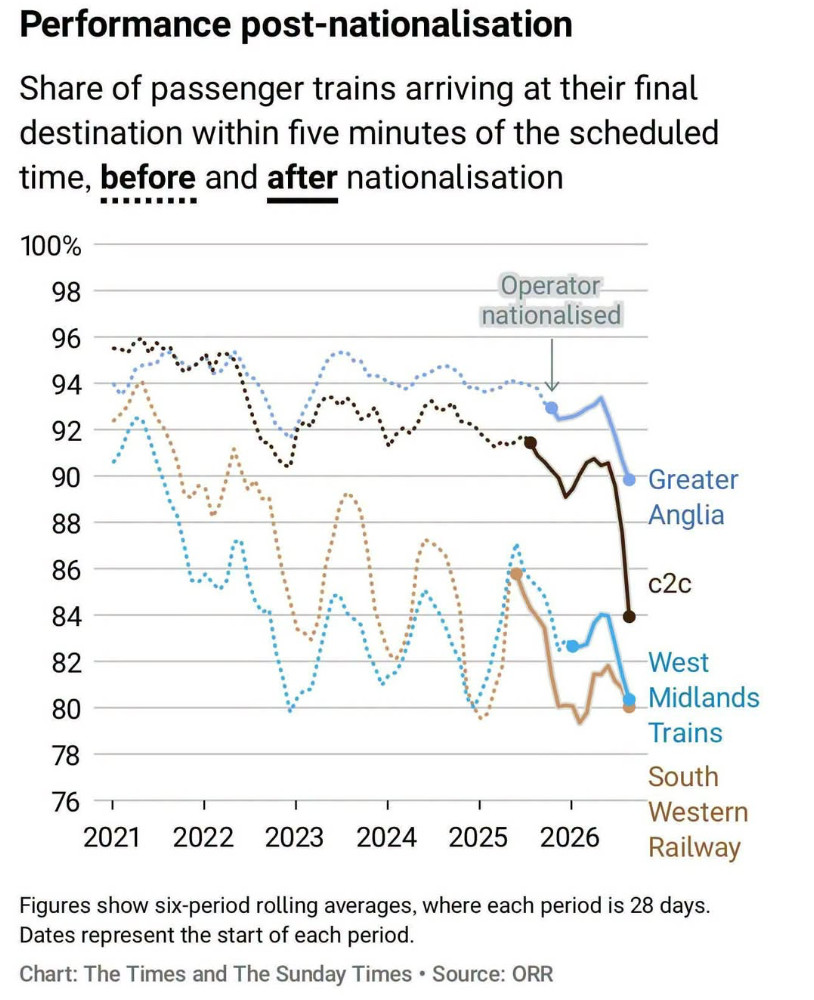
Now ... it may be biased by a careful choice of starting date and making no reference to other factors, but I found this diagram from The Time via "Down the line" rather interesting to consider.
| Re: GWR reassures passengers: No radical change after nationalisation on 13 Dec 2026 Posted by a-driver at 10:05, 14th November 2026 | |
Now ... it may be biased by a careful choice of starting date and making no reference to other factors, but I found this diagram from The Time via "Down the line" rather interesting to consider.
But there's another graph going round which shows the same sort of drop in performance on the privatised TOC's, to me, that's more indicative of the state of the infrastructure then anything.
